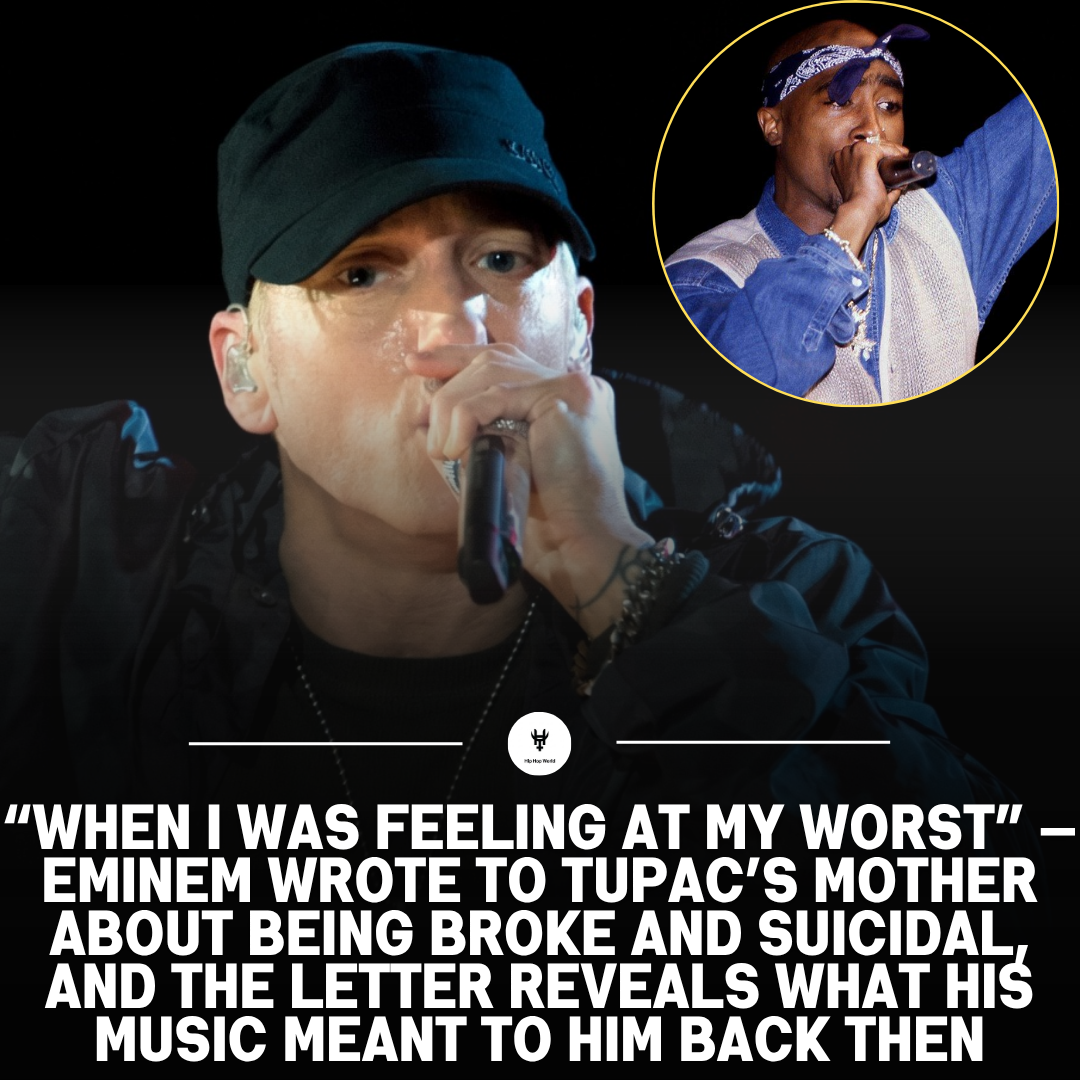
Eminem was broke, suicidal, and unknown — and the only thing getting him through the night was a Tupac tape.
This was Detroit, 1996. No Dre. No deal. No indication that any of it would ever work out. That year, Eminem released his debut album Infinite to near-total silence. The industry ignored it. The world didn’t notice. By every visible measure, he was just another rapper who wasn’t going to make it.
But on the worst nights, he’d press play. And somehow, that was enough to keep going.
The Letter
Years later — after the fame, after the Grammys, after the world learned his name — Eminem did something quietly remarkable. He sat down and wrote a handwritten letter to Afeni Shakur, Tupac’s mother.
He included a pencil sketch of Tupac inside the envelope, noting in the letter that it looked “a little sloppy.” The sketch was later displayed at the Tupac Amaru Shakur Center for the Arts, the foundation Afeni had built in her son’s memory in 1997.
But it was the words that hit hardest.
Eminem went back to that version of himself — the one before everything changed — and named it plainly. “When I was feeling at my ‘worst’: (before fame, before Dre),” he wrote, “I knew I could put that Tupac tape in, and suddenly, things weren’t so bad. He gave me the courage to stand up and say, ‘Fk the world! This is who I am! And if you don’t like it, go fk yourself!'”
He closed it simply: “Thank you for giving us his spirit and yours! God Bless you! Love, Marshall.”
The Woman Behind the Legend
Afeni Shakur was not simply a grieving mother. Long before her son became a symbol, she had spent decades fighting — as a member of the Black Panther Party, as a civil rights advocate, as a woman who stood beside the Gay Liberation Front when few others would. She was someone who understood sacrifice on a level most people never reach.
Eminem knew that. The letter wasn’t just addressed to a mother. It was addressed to a woman he genuinely respected.
It’s believed he wrote it around 2004, after being given the honor of producing Loyal to the Game — Tupac’s posthumous album. A full-circle moment. A chance to give something back to the legacy that had carried him through his lowest point.
What Gets Left Behind
Fame rewrites people. It smooths out the desperation, replaces the hunger with mythology, makes the struggle sound romantic in hindsight. Eminem didn’t let that happen here.
He went back to the worst nights. He named them. And he made sure the right person knew what her son had meant to a broke kid in Detroit who had no reason left to believe — except for a tape he kept coming back to.
Sometimes that’s all it takes.
And sometimes, the most important thing you can do is make sure someone knows it.