The lights are still low. The bass is still heavy. But something feels off.
Inside clubs that once thrived on anticipation—the moment a song drops and the entire room moves as one—there’s now a strange stillness. Heads tilt downward. Screens glow brighter than faces. The energy isn’t gone, but it’s scattered. Disconnected.
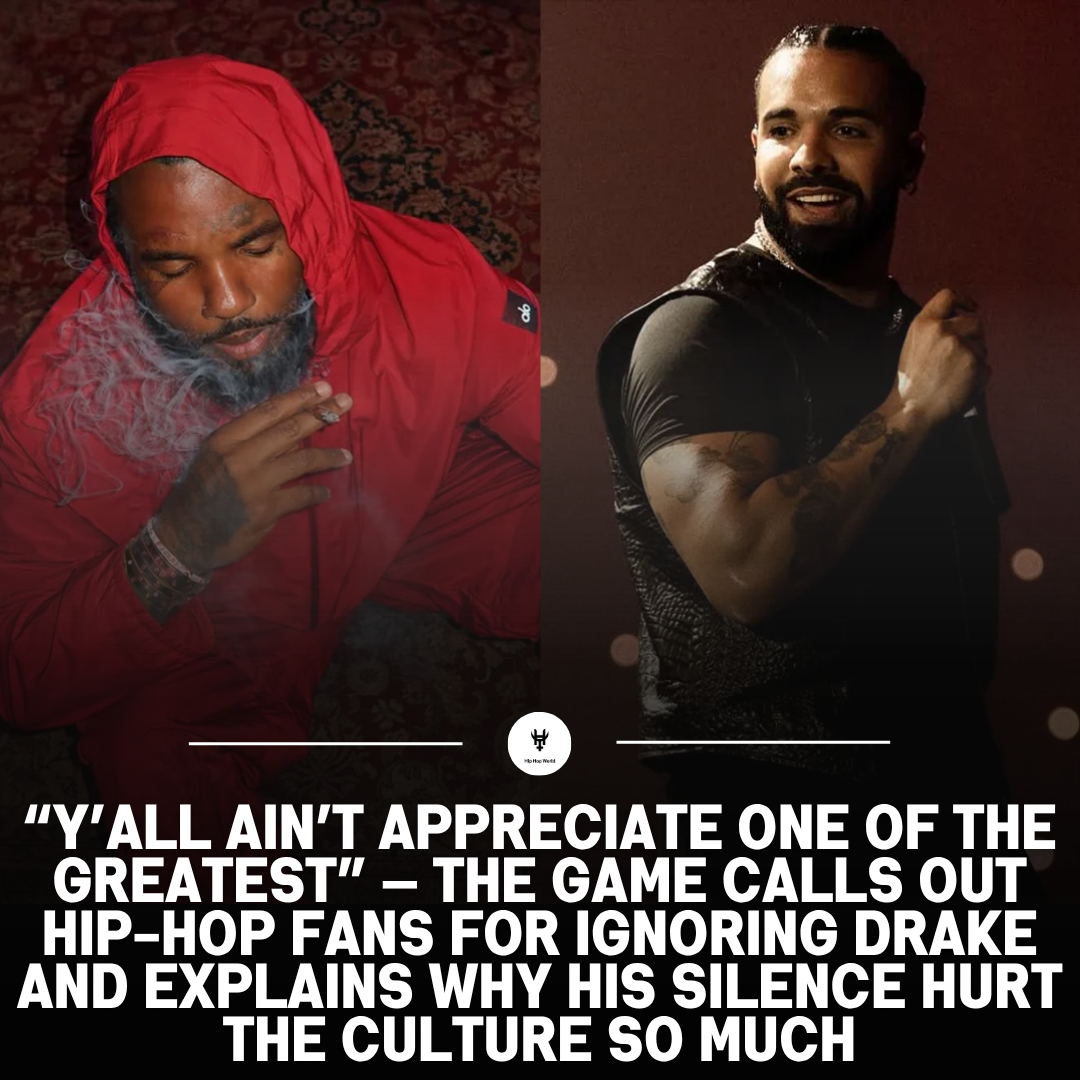
For The Game, the explanation is simple—and blunt. The absence of Drake has left a noticeable void.
A Gap No One Filled
It’s been years since Drake last delivered a solo album, with For All the Dogs marking his most recent full-length statement. Since then, he’s remained present—but not dominant in the way fans had grown used to. No era-defining rollout. No undeniable club takeover.
Now, with Iceman on the horizon, conversations are shifting again. But according to Game, the damage—at least culturally—has already been felt.
Taking to Instagram, he didn’t hold back: “Y’all ain’t appreciate one of the greatest now the absence and silence has the art form down 50 per cent.”
It’s not just about numbers or charts. For Game, it’s about feeling—something he believes has been missing in real-world spaces like clubs.
When the Music Stops Moving People
Speaking with Complex, Game painted a picture that feels less like criticism and more like frustration.
“You gotta think… ever since Drake been quiet or chillin’ or not Drake in his usual, the world all fucked up, bro,” he said. “You walk in the clubs, everybody on their phone, nobody looks like they’re having a good time no more.”
It’s a harsh take—but it hits on something deeper than nostalgia. Drake’s music wasn’t just popular; it was functional. It created moments. Hooks that everyone knew. Drops that forced reactions.
Game pushes the point further, questioning what today’s equivalent even is.
“If you walked in the club today, what song would make you happy about being there right now? Yeat gonna come on and turn y’all up? He gonna turn y’all section up? And I’m not shittin’ on Yeat; I’m sayin’ this is why Drake needs to go up.”
It’s not necessarily a knock on newer artists—it’s a comparison of impact. The kind that’s hard to measure but easy to feel when it’s missing.
Appreciation Comes Late
There’s another layer to Game’s argument, and it’s more personal.
He believes Drake’s current distance isn’t accidental—it’s a response.
“But we got Drake out here feeling like we didn’t appreciate him, so now he tucked away working on Iceman, chillin’ like, ‘They don’t appreciate me.’ He should never feel that way.”
It’s a familiar pattern in music. Artists dominate, get scrutinized, then step back—only for their absence to highlight what they brought.
Drake, for over a decade, sat at the center of hip-hop’s mainstream pulse. Whether through melodic hooks, introspective verses, or genre-blending risks, he consistently shaped what the moment sounded like.
And now, without that constant presence, the contrast feels louder.
History Between Them
Game’s defense of Drake isn’t new. Their connection goes back to collaborations like “100” from The Documentary 2, where both artists operated in sync—different styles, same control over the moment.
Over the years, Game has repeatedly placed Drake in conversations reserved for the elite. Not just as a hitmaker, but as a cultural driver.
This recent defense feels less like promotion and more like concern. Not for Drake’s career—but for the space he left behind.
Waiting for the Shift
With Iceman set to arrive, the question isn’t just about numbers or streams. It’s about whether Drake can restore something intangible—an atmosphere that used to feel automatic.
Because if Game is right, the issue isn’t that music stopped. It’s that the experience changed.
Clubs still play songs. People still show up. But the shared moment—the one where a track instantly connects everyone in the room—has become harder to find.
And maybe that’s what Drake represented more than anything.
Not just dominance.
But unity in sound.