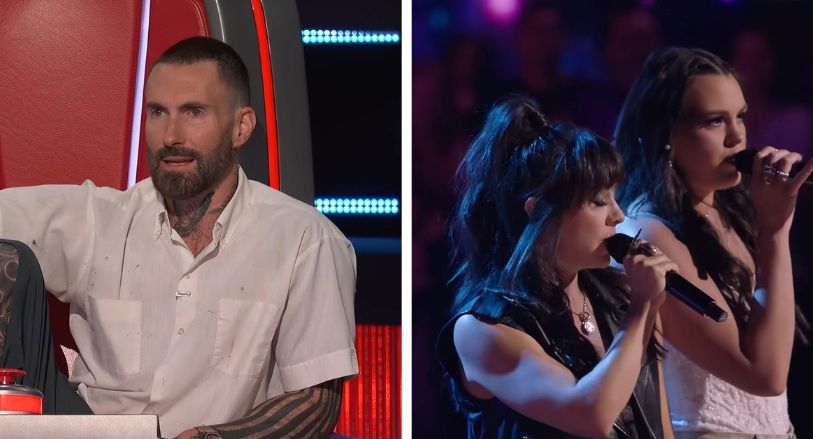
Adam Levine believes Lexi Stephens has what it takes to reach The Voice finale, but a performance of one of Paramore’s most emotionally demanding songs has sparked a very different conversation among viewers. When Stephens and Marilyn Hucek took on “All I Wanted” during the October 26 Battle Round, the coaches praised their vocal abilities, while some longtime Paramore fans questioned whether the cover captured what made the original so powerful.
The disagreement reveals a challenge that goes beyond deciding which contestant won a Battle. When singers tackle a song with a devoted fan base, they are not simply being judged on vocal range or technical ability. They are also confronting listeners’ emotional connections to the original, and those expectations can be difficult to satisfy.
For Stephens, the performance nevertheless ended with a significant endorsement from her coach. Levine chose her to advance and described her as “otherworldly,” adding that he believed she could become his finalist. His confidence in the singer was unmistakable, even as the online response to the Paramore cover became divided.
The Battle paired two artists with different vocal personalities. Stephens brought the power and presence that have impressed Levine throughout the competition, while Hucek offered a distinctive tone that other coaches connected with her alternative-rock sensibilities. Their assignment was “All I Wanted,” a Paramore song released on the band’s 2009 album, Brand New Eyes.

Before the performance, Levine and Team Adam advisor Alex Warren helped the contestants prepare. Levine praised Stephens as exceptionally gifted, while Warren highlighted Hucek’s individual voice and personality. The pairing offered the opportunity for two different approaches to meet in a song known for its demanding vocals and emotional intensity.
Once the performance was over, the coaches had plenty to say about both singers. Queen Latifah pointed to Stephens’ lower register and Hucek’s vocal texture and vibrato, recognizing the qualities that made the pair different. Riley Green appreciated Hucek’s 1990s punk-rock feel, while Kelly Clarkson praised Hucek’s fun delivery and Stephens’ powerful vocals.
Levine, however, appeared especially taken with Stephens. He told her that her power, presence, and musical instincts intimidated him, making it clear that he saw something exceptional in her performance. Although he acknowledged that Hucek had also delivered a strong showing, he ultimately decided Stephens was the artist he wanted to take forward.
His post-Battle assessment was even more direct. Levine said Stephens could sing anything and described her as a potential finalist, a statement that sets a high bar for her next appearance. It also gives viewers a reason to watch how she handles future song choices, particularly if she continues to receive opportunities to showcase her range.
But the coaches’ praise did not settle the debate. Under the show’s social media post, some Paramore listeners objected to the cover, arguing that the arrangement and vocal approach missed the emotional character they associate with the original. Several commenters specifically referenced Hayley Williams, whose distinctive delivery is central to the way many fans experience the song.
One listener who identified as a longtime Paramore and Williams fan said the performance did not work for them, while another jokingly suggested that Williams should not be told about the cover. Other comments questioned whether the song’s emotional intensity had been preserved, with some viewers describing the interpretation as overly showy or too far removed from Paramore’s alternative-rock sound.
The criticism was not simply that Stephens and Hucek lacked vocal ability. In fact, some detractors explicitly acknowledged that both contestants could sing, while arguing that technical skill alone could not deliver the feeling they wanted from this particular song. For listeners who have a deep connection to the original, the emotional impact can matter just as much as the notes themselves.
That distinction helps explain why the performance prompted such different responses. A singing competition rewards contestants for demonstrating control, range, stage presence, and individuality. Fans of a beloved recording, meanwhile, may be listening for the tension, vulnerability, and stylistic choices that made the original meaningful to them. Those expectations can overlap, but they are not always the same.

Still, the reaction was far from unanimous. Some viewers defended the contestants, arguing that covering a famous song should not require reproducing the original singer’s sound. One supporter pointed out that both women sounded great in their own ways and that performing a Paramore song did not mean they had to imitate Williams. Others praised the Battle outright, with one viewer calling it a personal favorite.
That disagreement raises a fair question about what makes a successful cover. Should a contestant respect the character of a beloved song, or should they reshape it to reveal something about their own voice? On a show like The Voice, the answer may depend on the song, the singer, and what the coach hopes to hear. An interpretation that disappoints some longtime fans might still demonstrate qualities that make a contestant valuable in the competition.
“All I Wanted” is a particularly demanding choice because listeners often associate it with Williams’ intense vocal performance. Trying to recreate that impact can invite comparisons, while changing the arrangement risks losing the qualities that made the song resonate in the first place. Stephens and Hucek were therefore facing more than a technical challenge: they were taking on a track with a strong identity and a passionate audience.
The outcome also leaves Hucek’s supporters with a difficult question. The coaches recognized her distinctive voice and style, but Levine ultimately had to choose one singer. His decision does not mean Hucek lacked talent; it means Stephens made the stronger case for the place he had available on his team. In a competition where only one artist can win a Battle, even a performance that earns praise can end in elimination.
For Stephens, the next step is to build on Levine’s confidence. Being called a potential finalist is a major vote of faith, but it also creates expectations for future performances. She will need to show that her power and versatility can connect with audiences across different musical styles, not just in a Battle that has generated a debate.
My take is that the most interesting question is not whether Stephens and Hucek sounded exactly like Paramore. It is whether their interpretation communicated something convincing in its own right. Fans are entitled to feel protective of a song that means a great deal to them, while contestants deserve to be judged on what they bring as performers rather than on imitation alone.
The Battle has now put two conversations side by side: Levine’s belief that Stephens could go all the way, and the disagreement over whether the Paramore cover worked. Do you think Stephens and Hucek should have approached “All I Wanted” closer to the original, or should singers be encouraged to take bigger creative risks with iconic songs?