At just 14 years old, Brianna Cameron is already being compared to one of the greatest voices in music history. Following her performance of Christina Aguilera’s “Reflection” on The Voice Season 30, some viewers heard qualities reminiscent of Whitney Houston, while all four coaches rose to their feet to applaud the young singer.
The comparisons are extraordinary for someone so early in her musical journey. But they also introduce a fascinating challenge as Cameron advances into the Top 10: can a teenager develop her own artistic identity while audiences are already measuring her against legendary performers?
Her November 16 performance demonstrated why those expectations are growing.
Representing Team Kelly Clarkson during the second night of Y2K Night, Cameron chose a song associated with one of pop music’s most technically accomplished vocalists. “Reflection” demands control, emotional sensitivity and the ability to build towards powerful moments without overwhelming the melody.
For a newly turned 14-year-old, it was an ambitious selection.
The song is particularly appropriate for a young performer beginning to discover her musical identity. Its lyrics explore the tension between how someone appears to the outside world and who they feel they truly are, a message that can resonate strongly during adolescence.
Cameron approached the performance with the confidence of someone willing to tackle difficult material rather than remain within a comfortable vocal range.
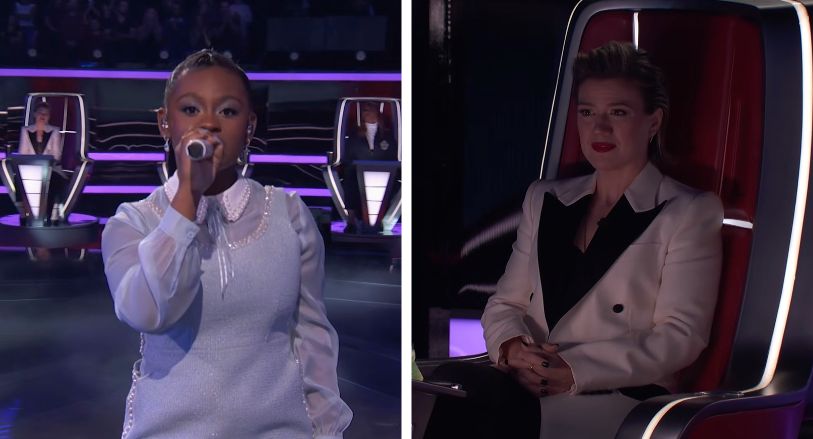
However, her preparation also revealed that even exceptional natural ability benefits from careful guidance.
During rehearsals, Clarkson recognised the challenge Cameron had chosen. Christina Aguilera is not only one of the most celebrated vocalists of her generation but also a former coach on The Voice, making the selection especially significant within the show’s history.
Clarkson encouraged Cameron to think more carefully about the emotional progression of the song.
Rather than delivering maximum vocal intensity immediately, she advised the teenager to build towards the biggest moments. The adjustment was intended to give the performance greater contrast and make its emotional climax more effective.
Cameron responded quickly.
Her ability to incorporate the advice impressed Clarkson so much that the coach jumped up in celebration during rehearsal. For Cameron, who had admired Clarkson long before joining the competition, the reaction was particularly meaningful.
The moment illustrated an important distinction between having a remarkable voice and understanding how to use it effectively.
Powerful singers can sometimes be tempted to demonstrate their full abilities throughout an entire song. But musical storytelling often depends on restraint, allowing quieter passages to create anticipation before the performance reaches its most demanding sections.
Clarkson’s guidance appeared to focus on helping Cameron develop precisely that skill.
When the teenager stepped onto the live stage, the preparation paid off.
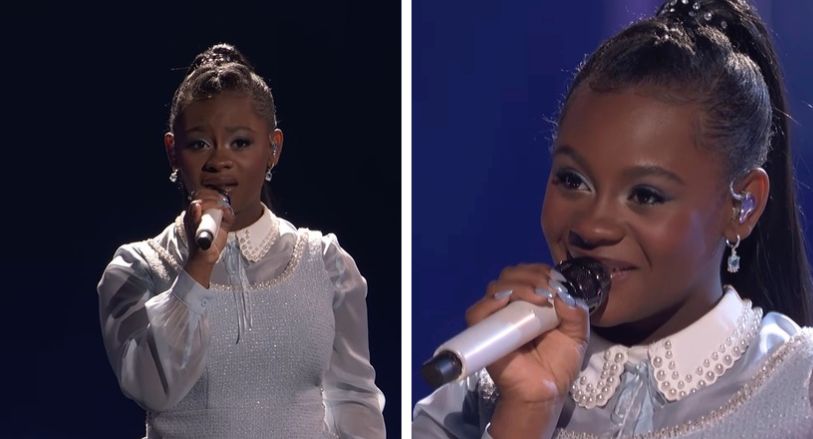
Her rendition of “Reflection” earned a standing ovation from Clarkson, Adam Levine, Riley Green and Queen Latifah. The unanimous response demonstrated how strongly the coaches appreciated what she had delivered.
Clarkson was especially enthusiastic.
She praised the clarity and purity of Cameron’s voice, expressing amazement that the contestant had only recently turned 14. The coach also acknowledged the difficulty of performing an Aguilera song, congratulating Cameron for handling such demanding material.
That reaction was particularly significant because Clarkson understands the pressures facing young singers in televised competitions.
Her own career began with a victory on American Idol in 2002, when she was 20 years old. Since then, she has developed into one of the most successful vocalists of her generation, building a career around powerful performances, emotional interpretation and musical versatility.
For Cameron, receiving guidance from an artist with that experience represents a valuable opportunity.
But the response from viewers introduced another dimension to her growing reputation.
Following the performance, several fans compared Cameron’s vocal tone to Whitney Houston, with one suggesting that she possessed qualities reminiscent of the late superstar’s voice. Another went further, describing her as a potential successor to Houston.
Those comments reflect the enthusiasm surrounding Cameron’s performances, but they also deserve careful perspective.
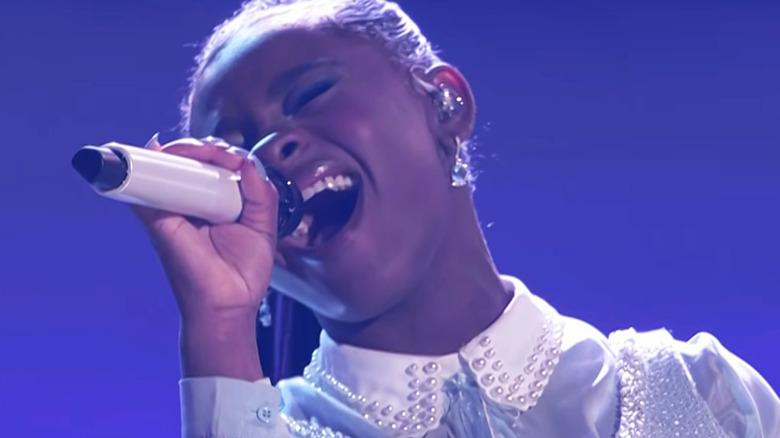
Whitney Houston’s legacy was built over decades of extraordinary recordings, live performances and commercial achievements. Her technical control, vocal power and emotional interpretation established standards that continue to influence singers around the world.
Comparing a 14-year-old contestant to such an accomplished performer is an expression of admiration, not evidence that the two artists have reached comparable levels of development.
Nevertheless, the comparison reveals what some listeners find distinctive about Cameron.
Her vocal clarity, ability to sustain demanding notes and willingness to approach technically challenging songs have created an impression of maturity beyond her years.
Those qualities can be especially striking when audiences remember how young she is.
At 14, most singers are still discovering their voices, experimenting with different musical styles and developing the confidence required to perform consistently in front of large audiences.
Cameron is navigating those challenges while appearing on national television.
That environment offers extraordinary opportunities, but it also creates expectations that can be difficult for any young performer to manage.
Each successful performance increases the pressure to deliver something even more impressive during the next round. Audiences begin anticipating bigger notes, more demanding songs and increasingly dramatic moments.
For a teenager whose voice is still developing, finding a balance between ambition and sustainable technique is particularly important.
Cameron’s performance also attracted some constructive criticism.
Although many viewers celebrated her high notes and emotional delivery, others questioned whether every moment was technically precise. Some suggested that her pitch or vocal range could still benefit from further refinement.
Those observations do not diminish the significance of her achievement.
Instead, they highlight the reality that a young performer can possess exceptional talent while still having considerable room to grow.
Indeed, the ability to respond to coaching may prove just as valuable as the natural vocal qualities that initially attracted attention.
Clarkson’s rehearsal advice demonstrated that Cameron is capable of making meaningful adjustments, an encouraging sign as the competition becomes increasingly demanding.
Her advancement into the Top 10 confirms that viewers responded strongly enough to keep her in the competition.
She now continues representing Team Kelly alongside Kyle Davis and Koumba Diallo, giving Clarkson three contestants in the remaining field.
The next challenge could provide an especially interesting test of Cameron’s musical development.
On November 23, the remaining artists are scheduled to perform during Dolly Parton Tribute Night, an episode celebrating one of country music’s most influential songwriters and performers.
Parton’s catalogue offers a different kind of vocal challenge from Christina Aguilera’s “Reflection.”
Although many of her songs have been interpreted through powerful arrangements, their emotional impact often comes from intimate storytelling, carefully controlled phrasing and an ability to communicate complicated feelings through relatively simple melodies.
For Cameron, the tribute could offer an opportunity to demonstrate another side of her talent.
Rather than concentrating primarily on impressive high notes, she may be able to explore the quieter emotional qualities that Clarkson encouraged during rehearsals.
Some fans have already speculated about whether Cameron or fellow Team Kelly contestant Koumba Diallo might perform “I Will Always Love You.”
The suggestion is especially intriguing because the song connects Dolly Parton and Whitney Houston, two artists whose musical legacies have become part of Cameron’s developing story.
Parton wrote and originally recorded the song in 1973, releasing it in 1974, while Houston’s 1992 interpretation transformed it into one of the most recognisable vocal performances in pop music history.
However, there has been no confirmation that Cameron will perform the song during the tribute episode.
Whatever she chooses, the challenge will be to deliver an interpretation that reflects her own strengths rather than simply attempting to reproduce a famous recording.
That distinction could become increasingly important as Season 30 approaches its final stages.
The Voice has introduced audiences to numerous talented young performers, but a memorable television appearance is only the beginning of an artist’s development.
Building a lasting career requires more than extraordinary vocal ability. Singers must establish a recognisable identity, make thoughtful musical decisions and develop the confidence to express something personal through their performances.
Cameron has already demonstrated considerable promise in those areas.
Her willingness to tackle difficult material, combined with her ability to respond to Clarkson’s guidance, suggests that she is approaching the competition with both ambition and openness to learning.
In my view, the most exciting aspect of Cameron’s journey is not the possibility that she could become another Whitney Houston. It is the opportunity to watch a gifted young performer discover what makes her own voice unique.
The comparisons may attract attention, but her long-term success will depend on moving beyond them.
As the Top 10 prepares for another demanding round, Cameron faces an important choice between continuing to impress audiences with spectacular vocal moments and developing the emotional depth that can make a performance unforgettable.
At only 14, she has time to explore both.
But with viewers already discussing her as a potential winner, the expectations surrounding her are growing quickly.
Can Brianna Cameron turn her remarkable natural talent into a winning performance on The Voice, or are comparisons to Whitney Houston placing too much pressure on a singer who is only beginning her musical journey?