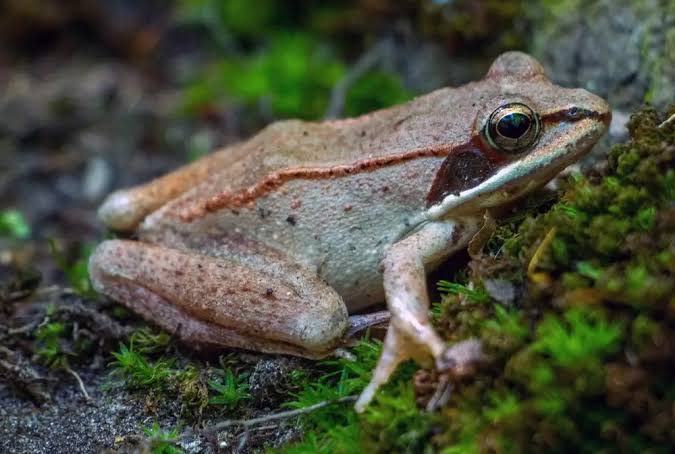
Imagine your heart stops beating, your blood stops circulating, and ice begins forming inside your body. For most animals, this would mean certain death. But for one extraordinary little frog, it’s simply a way of surviving winter.
Meet the wood frog (Lithobates sylvaticus), one of nature’s most remarkable survivors. While other animals migrate to warmer climates or retreat deep underground, this amphibian has evolved an astonishing ability to survive being partially frozen.
When temperatures rise again, its heart starts beating, its muscles regain movement, and it continues its life as though nothing extraordinary has happened.
The Little Frog That Defies Winter
Found throughout North America, including Canada and Alaska, the wood frog inhabits some of the coldest environments where amphibians can survive.
Despite measuring only around two to three inches in length, this seemingly ordinary creature possesses one of the most extraordinary survival mechanisms in the animal kingdom.
Rather than escaping freezing temperatures, wood frogs shelter beneath fallen leaves and forest debris, allowing their bodies to undergo a remarkable biological transformation.
As winter arrives, ice begins forming within their bodies, and their normal bodily functions gradually shut down.
Its Heart Stops Beating
One of the most astonishing aspects of the wood frog’s survival strategy is what happens to its vital organs.
During freezing:
- Its heart stops beating.
- Breathing ceases.
- Blood circulation stops.
- Muscle movement becomes impossible.
- A substantial proportion of its body water turns into ice.
Under normal circumstances, these conditions would be fatal to most vertebrates.
Yet the wood frog remains alive in a state of suspended physiological activity, waiting for environmental conditions to improve.
Under certain conditions, approximately two-thirds of its body water can freeze without causing irreversible damage.
The Secret Behind Its Incredible Survival
How does an animal survive something that would kill most other creatures?
The answer lies in its extraordinary natural chemistry.
When freezing begins, the wood frog’s liver rapidly releases large quantities of glucose into its bloodstream. This glucose, together with other protective substances such as urea, helps protect its cells against freezing-related damage.
These substances act somewhat like a natural biological antifreeze, although they do not prevent the entire body from freezing.
Instead, they help protect the delicate structures inside cells while ice forms primarily outside them.
This distinction is crucial. Ice crystals forming inside cells can damage membranes and destroy tissues. By controlling where ice forms and protecting its cells from dehydration, the wood frog survives conditions that would otherwise be devastating.
Its metabolism also slows dramatically, reducing the amount of energy and oxygen its tissues require.
Surviving Months in the Alaskan Wilderness
Wood frogs living in Alaska possess particularly impressive cold-weather adaptations.
Researchers have documented northern populations surviving prolonged periods of freezing, with some experiencing temperatures as low as approximately −16°C (3°F) under natural winter conditions.
Their bodies prepare for winter by accumulating protective compounds that help them withstand extreme cold.
For months, these tiny amphibians can remain beneath the forest floor, motionless and without a functioning heartbeat.
They do not hunt, eat or move. Their survival depends entirely on biological adaptations refined through generations of evolution.
However, even wood frogs have limits. Their ability to survive depends on factors including temperature, freezing duration and their physiological condition.
What Happens When Spring Arrives?
As winter ends and temperatures gradually rise, something remarkable happens.
The ice inside the frog’s body begins to melt. Its heart resumes beating, blood starts circulating again, and oxygen returns to its tissues.
Over time, the frog regains control of its muscles and begins moving.
Depending on environmental conditions, recovery can take several hours or longer.
Once sufficiently recovered, wood frogs emerge from their winter shelters and begin searching for breeding ponds.
After spending much of winter in a frozen, motionless state, they return to the forest and continue their natural life cycle.
It is one of the most extraordinary seasonal transformations found in nature.
Could This Frog Help Scientists Save Human Lives?
The wood frog’s remarkable biology has attracted attention from researchers studying cryobiology — the science of how extremely low temperatures affect living organisms.
One potential application involves improving the preservation of human organs for transplantation.
Currently, donated organs can only be preserved outside the human body for limited periods. Freezing them without causing significant cellular damage remains an enormous scientific challenge.
Understanding how wood frogs protect their cells and tissues during freezing could potentially contribute to research into:
- Long-term organ preservation.
- Improved tissue storage.
- Protection against cellular damage.
- Medical cryopreservation technologies.
- Recovery from oxygen deprivation.
Scientists have not yet replicated the wood frog’s extraordinary abilities in humans, but its natural survival mechanisms offer valuable insights into how living tissues respond to extreme conditions.
Is the Wood Frog the Only Animal That Can Survive Freezing?
Although the wood frog is among the most remarkable freeze-tolerant vertebrates, it is not alone.
Several other animals possess adaptations that allow them to survive freezing or extreme cold, including certain insects, amphibians and microscopic organisms.
Some produce protective proteins, while others accumulate sugars and chemical compounds that help prevent cellular damage.
However, the wood frog stands out because of its ability to survive extensive freezing throughout its body, including the temporary cessation of heartbeat and breathing.
For such a relatively complex animal, this is an exceptional biological achievement.
Nature’s Extraordinary Survivor
The wood frog may not possess the strength of a lion, the speed of a cheetah or the intimidating appearance of a crocodile.
But its survival abilities are equally extraordinary.
Every winter, this tiny amphibian demonstrates that nature has developed solutions to challenges that modern science is still working to overcome.
Its heart stops. Its breathing ceases. Much of its body water freezes.
And when spring returns, it begins moving again.
The next time you think about the toughest animals on Earth, remember the little wood frog hiding beneath the frozen forest floor.
Sometimes, the most extraordinary survivors come in the smallest packages.