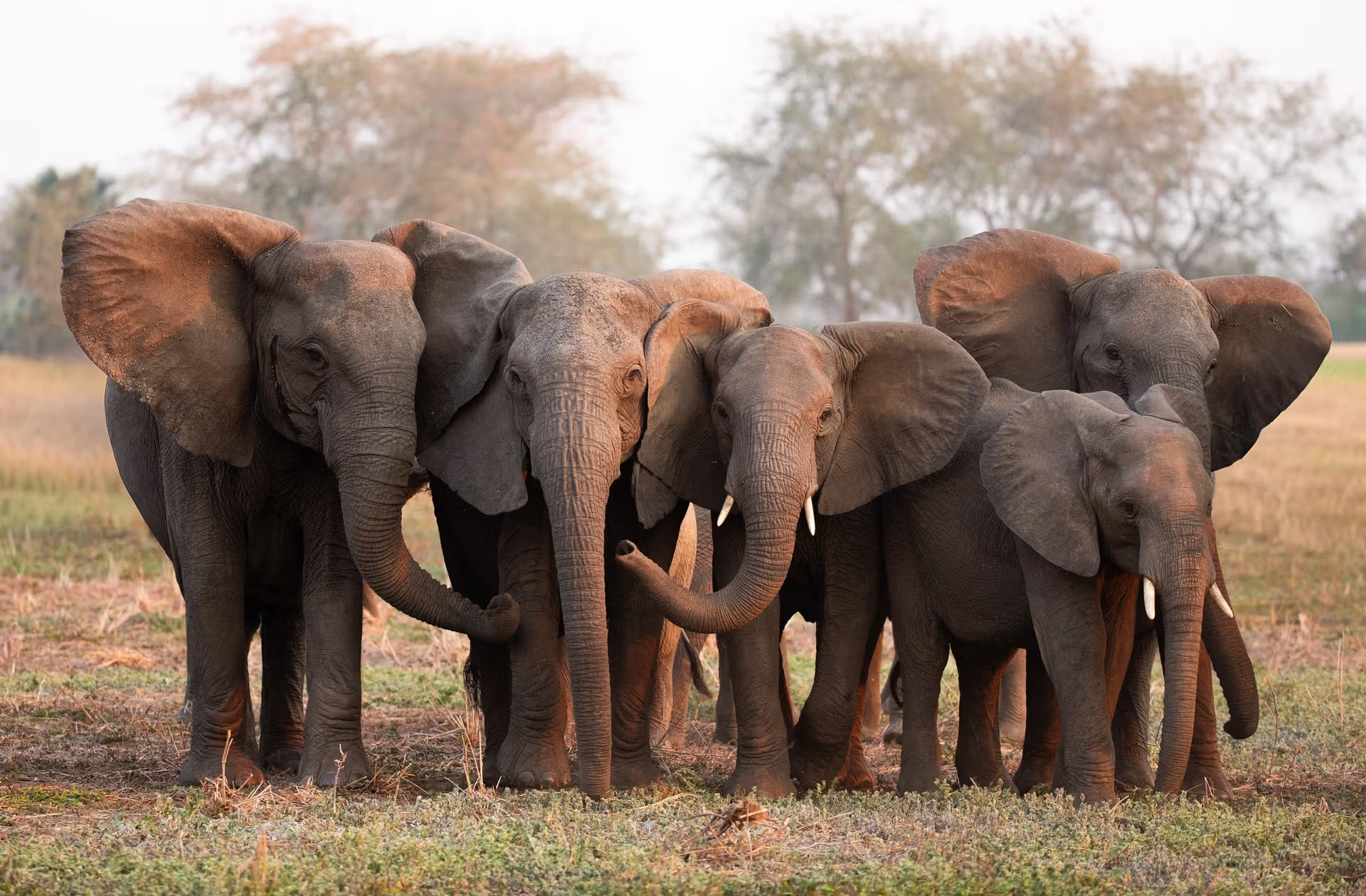
Deep in the African wilderness, an elephant approaches the remains of another elephant. Instead of walking past, it stops, gently touches the bones with its trunk and remains nearby.
What makes this behaviour particularly remarkable is that elephants sometimes show interest in the remains of their own species long after death.
These magnificent animals are renowned for their intelligence, extraordinary memory and powerful family bonds. But their behaviour around deceased companions reveals another fascinating side of their nature.
Could elephants experience grief in ways similar to humans?
The Extraordinary Family Bonds of Elephants
Elephants are among the most socially complex animals on Earth. Their family groups are typically led by an experienced female known as the matriarch, who guides younger generations and helps protect the herd.
Family members develop strong relationships through years of living, travelling and raising their young together.
Elephants communicate through vocalisations, physical contact and low-frequency sounds capable of travelling considerable distances.
When a member of the herd becomes injured or vulnerable, other elephants may remain nearby, offer physical support or attempt to help.
These powerful social connections make their responses to death particularly fascinating.
What Happens When an Elephant Dies?
Researchers observing elephants in the wild have documented remarkable behaviour around deceased members of their species.
Elephants have been observed:
- Gently touching deceased companions with their trunks.
- Remaining near bodies for extended periods.
- Attempting to lift or support unresponsive elephants.
- Investigating the skulls, tusks and bones of deceased elephants.
- Returning to locations where other elephants have died.
Such behaviour suggests that death holds particular significance within elephant society.
Unlike many animals that quickly abandon deceased companions, elephants sometimes display prolonged attention towards their remains.
A Mother’s Heartbreaking Response
Some of the most emotionally powerful observations involve elephant mothers and their deceased calves.
Mothers have been documented remaining close to their dead young, touching them repeatedly and attempting to lift or move their bodies.
There have also been observations of Asian elephants carrying deceased calves.
These behaviours can continue even when the calf is no longer responsive.
Although scientists cannot determine exactly what an elephant experiences emotionally, such observations demonstrate the extraordinary strength of maternal bonds.
For an animal whose offspring require years of protection, guidance and care, the loss of a calf represents a profound disruption to its social world.
Why Do Elephants Return to the Bones of the Dead?
Perhaps one of the most mysterious aspects of elephant behaviour is their fascination with the remains of other elephants.
Even when a body has decomposed, elephants may stop to investigate its skull, tusks or bones.
They use their sensitive trunks to explore the remains, sometimes moving bones or spending considerable time examining them.
Scientific experiments have demonstrated that African elephants show particular interest in elephant skulls and ivory compared with the remains of other large mammals.
Interestingly, this behaviour is not necessarily limited to deceased relatives.
Elephants may investigate the remains of individuals they never knew, raising fascinating questions about their awareness of death and their ability to recognise members of their own species.
Do Elephants Really Mourn Their Dead?
Grief is a complex emotional experience, and proving that another species experiences it exactly as humans do is extremely difficult.
However, elephants display behaviours consistent with mourning, including prolonged attention to deceased companions and attempts to interact with individuals that are no longer alive.
Their sophisticated social structures, impressive cognitive abilities and long-lasting relationships make the possibility of grief particularly compelling.
Scientists remain cautious about assigning human emotions to animals, but the evidence suggests that elephant responses to death are far more complex than simple curiosity alone.
The Remarkable Memory of Elephants
The famous expression that elephants never forget is rooted in their impressive memory.
Experienced matriarchs retain valuable knowledge about their surroundings, including water sources, migration routes and potential threats.
Elephants can also recognise familiar individuals through sound and scent, even after periods of separation.
This ability is essential for maintaining relationships within their complex social networks.
Their extraordinary memory may help explain why the disappearance of familiar companions can be particularly significant.
However, researchers have not established that elephants remember every deceased individual or understand death in precisely the same way humans do.
Why Protecting Elephant Families Matters
Poaching, habitat destruction and human-wildlife conflict threaten elephant populations across the world.
The loss of an elephant, particularly an experienced matriarch, can affect more than the survival of a single individual.
Younger elephants may lose an important source of social knowledge, protection and guidance.
Disrupting established family groups can also affect the relationships and behaviour of surviving members.
Protecting elephants therefore means preserving not only individual animals but also the complex social communities they depend upon.
A Powerful Reminder of the Emotional Complexity of Nature
Elephants are celebrated for their enormous size, remarkable strength and intelligence. Yet some of their most extraordinary qualities are revealed in their quietest moments.
A mother remaining beside her calf. A herd gathering around a fallen companion. An elephant gently examining the bones of another.
These moments remind us that the animal kingdom contains forms of social attachment and emotional complexity that humanity is still learning to understand.
We may never know exactly what an elephant feels when it loses a loved one.
But its behaviour offers a powerful reminder that the bonds connecting living creatures can be far deeper than we once imagined.