Imagine growing old, only to transform back into a younger version of yourself and begin your life all over again. No medicine, no surgery and no futuristic technology — just a natural biological ability.
It sounds like something straight out of science fiction, yet one tiny marine creature possesses this extraordinary power.
Known scientifically as Turritopsis dohrnii, the immortal jellyfish has fascinated scientists with its remarkable ability to reverse its life cycle, potentially escaping the natural ageing process.
But how does this mysterious creature accomplish something that humans have dreamed about for centuries?
Meet the World’s Immortal Jellyfish
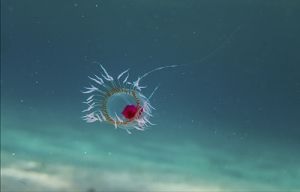
Measuring approximately four to five millimetres across, the immortal jellyfish is smaller than a human fingernail.
Its transparent, bell-shaped body contains a distinctive reddish stomach, surrounded by delicate tentacles. Despite its unremarkable appearance, it possesses one of the most fascinating biological abilities ever discovered.
Originally described from the Mediterranean region, the species has since been recorded in waters around the world.
Unlike most animals, which follow a predictable journey from birth to maturity and eventually death, this jellyfish can effectively turn back its biological clock.
How Does It Reverse Its Own Ageing?
Most jellyfish begin life as tiny larvae before settling onto a surface and developing into structures known as polyps.
These polyps eventually produce young jellyfish, which grow into mature, free-swimming adults.
Normally, this process moves in only one direction.
The immortal jellyfish, however, can reverse it.
When faced with environmental stress, physical injury or starvation, the adult jellyfish can undergo an extraordinary transformation.
Its bell contracts, its tentacles are absorbed, and its body develops into a cyst-like structure. From this structure, new polyps can emerge, eventually producing young jellyfish.
Instead of continuing towards the end of its life cycle, it returns to an earlier developmental stage.
Under suitable conditions, this process can happen repeatedly.
The Extraordinary Science Behind Its Ability
One of the key biological mechanisms associated with this transformation is called transdifferentiation.
This process allows specialised cells to change their identity and become different types of cells.
In most animals, mature cells have relatively fixed functions. Muscle cells perform muscular functions, while nerve cells transmit signals.
The immortal jellyfish possesses remarkable cellular flexibility, allowing its tissues to reorganise during life-cycle reversal.
Researchers have also identified genetic characteristics associated with DNA repair, cellular maintenance and developmental flexibility that may contribute to its extraordinary abilities.
Scientists are still investigating exactly how these mechanisms work together.
Understanding them could reveal important insights into ageing, tissue regeneration and cellular damage.
Is the Immortal Jellyfish Really Immortal?
Despite its famous nickname, the immortal jellyfish is not invincible.
It can still die from disease, infection, environmental changes or injuries that prevent successful regeneration.
It can also be eaten by predators before it has the opportunity to reverse its life cycle.
Its extraordinary ability does not guarantee eternal life. Rather, it means that under suitable conditions, it can potentially avoid the usual endpoint of its adult life cycle by returning to an earlier stage.
There is no established maximum number of times this transformation can occur.
However, scientists have not demonstrated that an individual jellyfish can survive forever.
Its immortality is therefore a biological possibility, not a guarantee.
Could Its Secrets Help Humans Live Longer?
For centuries, humans have searched for ways to slow ageing, repair damaged tissues and extend healthy lifespans.
The immortal jellyfish offers researchers a fascinating opportunity to investigate how living organisms can reorganise their cells and reverse aspects of their development.
Its biology could provide valuable insights into:
- Cellular ageing and regeneration.
- DNA repair mechanisms.
- Stem cell research.
- Tissue regeneration.
- Age-related diseases.
However, the human body is vastly more complex than that of a jellyfish.
Reversing human ageing would require overcoming enormous biological challenges, and there is currently no evidence that the jellyfish’s mechanism can be directly applied to make humans biologically immortal.
Nevertheless, studying this extraordinary creature could help scientists better understand the fundamental processes that govern ageing.
Why Haven’t Immortal Jellyfish Taken Over the Oceans?
If these jellyfish can repeatedly restart their lives, why aren’t the oceans overflowing with them?
The answer lies in the harsh realities of nature.
Like other small marine organisms, immortal jellyfish face constant environmental pressures.
Predators, food shortages, diseases and unsuitable water conditions can all threaten their survival.
Their ability to reverse development provides an extraordinary advantage, but it cannot protect them against every danger.
Furthermore, successful life-cycle reversal requires suitable environmental and biological conditions.
Nature has given this creature an exceptional survival mechanism, not unlimited protection.
One of Nature’s Greatest Biological Mysteries
The immortal jellyfish challenges our understanding of what it means to grow old.
While most animals move through life in one direction, this tiny ocean inhabitant possesses the remarkable ability to return to an earlier stage of existence.
It cannot escape every danger, and it may never truly live forever. Yet its extraordinary biology demonstrates that ageing and development are far more flexible in nature than we might imagine.
Somewhere beneath the ocean’s surface, a creature smaller than a fingernail may be restarting its life while scientists continue searching for the secrets behind its remarkable transformation.
Perhaps one of the greatest mysteries of ageing lies within one of the smallest creatures in the sea.