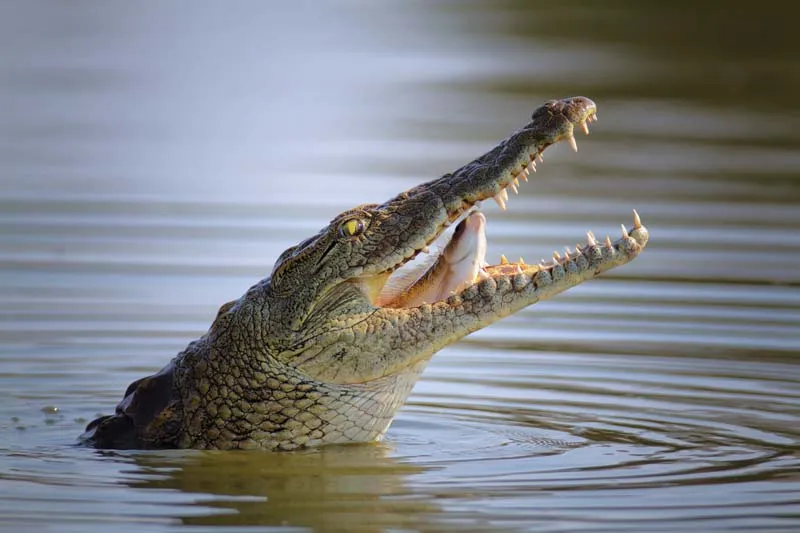
Imagine looking across a quiet river and seeing nothing unusual. The water appears completely still. But just beneath the surface, a massive crocodile could be watching its surroundings, waiting patiently for the perfect opportunity. With only its eyes and nostrils exposed, this powerful predator can remain remarkably difficult to detect. How does it manage to disappear so effectively?
Crocodiles have survived for millions of years, developing a collection of extraordinary adaptations that make them some of the most successful ambush predators on Earth.
Their ability to remain almost invisible underwater is not down to one special trick. It is the result of their body structure, specialised senses, camouflage and remarkable patience.
Here are five fascinating reasons why crocodiles are so difficult to spot.
1. They Can Breathe While Almost Completely Submerged
One of the most impressive features of a crocodile is the position of its eyes, ears and nostrils.
These structures sit towards the top of its head.
This allows the animal to keep most of its body underwater while exposing only a small part of its head.
Its nostrils remain above the surface, allowing it to breathe without exposing its entire body.
Its eyes also stay above the water, giving it the ability to observe its surroundings.
From a distance, a crocodile can look like little more than a floating log or a pair of small bumps on the water.
2. Its Eyes Are Adapted for Life in the Water
Crocodiles have specially adapted eyes that help them see in different lighting conditions.
One particularly interesting feature is a transparent third eyelid called the nictitating membrane.
This membrane moves across the eye and helps protect it underwater while still allowing the crocodile to see.
Crocodiles also have a reflective layer behind the retina called the tapetum lucidum.
It reflects light back through the retina, improving vision in low-light conditions.
This is one reason crocodiles can be effective hunters around dawn, dusk and at night.
3. Their Skin Helps Them Blend Into Their Surroundings
A crocodile’s appearance is another important part of its camouflage.
Many species have dark, earthy colours that blend naturally with muddy riverbanks, murky water and vegetation.
Their rough, textured skin also breaks up the outline of their bodies.
When a crocodile remains motionless, its shape can become difficult to distinguish from logs, rocks and other objects in the water.
Combined with floating vegetation and natural shadows, this camouflage can make a large predator surprisingly difficult to recognise.
4. They Can Detect Movement Without Seeing Everything
Crocodiles have another remarkable sensory adaptation.
Along their jaws and parts of their bodies are specialised sensory organs called integumentary sense organs.
These structures can detect disturbances and pressure changes in the surrounding water.
Even small movements can create ripples and vibrations that a crocodile may be able to detect.
This helps it gather information about nearby animals, even when visibility underwater is poor.
In other words, crocodiles do not rely on their eyesight alone to understand what is happening around them.
5. Their Greatest Hunting Advantage Is Patience
Perhaps the most impressive characteristic of crocodiles is how little movement they need to make.
Unlike predators that actively chase their prey over long distances, crocodiles often rely on ambush hunting.
They can remain motionless for extended periods, conserving energy while waiting for an opportunity.
When the moment comes, they can launch a remarkably powerful attack.
Their muscular tails provide strong propulsion through the water, while their jaws are equipped with powerful muscles designed to grip and hold prey.
The contrast between their almost motionless behaviour and explosive bursts of movement is what makes them such effective predators.
Are Crocodiles Really Invisible Underwater?
Not quite.
Crocodiles are not invisible, and their camouflage is not perfect.
Their ability to remain hidden depends on several factors, including water clarity, lighting, vegetation, distance and the angle from which they are observed.
However, their combination of specialised anatomy, sensory abilities and patient hunting behaviour makes them exceptionally difficult to detect in certain environments.
This is also why crocodiles should never be approached or treated as harmless animals, even when they appear completely motionless.
One of Nature’s Most Remarkable Predators
Crocodiles may look like ancient reptiles that have changed very little over time, but their bodies are remarkably well adapted to their environment.
Their ability to breathe while submerged, protect their eyes underwater, detect movement through specialised sensory organs and remain hidden for long periods makes them formidable predators.
And perhaps the most fascinating thing is that a crocodile does not need to chase everything it encounters.
Sometimes, it simply waits.
The next time you look across a quiet river, remember that what appears to be an ordinary patch of water may be hiding one of nature’s most perfectly adapted ambush predators.