The ocean mist was thick that afternoon in Asbury Park, the kind that softened the sky into a blur and turned memories into something you could almost touch. Bruce Springsteen, in a faded denim jacket and scuffed boots, stood staring at a weathered bench facing the Atlantic. He turned to Paul McCartney and Bob Dylan, who were just a few steps behind him.
“This is it,” Bruce said quietly, patting the wooden slats. “Right here. I wrote ‘Born to Run’ with sand in my shoes and no money in my pocket.”
They sat, three giants in silence, watching waves roll in like verses without music. Each held a fish sandwich wrapped in wax paper—Bruce’s idea, “old boardwalk tradition,” he’d said.
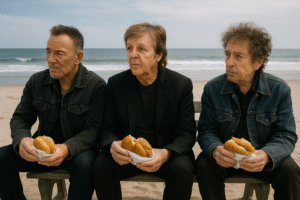
Bob was the first to speak. “Newport,” he muttered between bites. “I still remember the boos. Not the cheers—those faded. But the boos… they stuck.”
Paul laughed gently. “You plugged in and set the world on fire. We all needed that.”
Bob just shrugged. “I needed it too. Otherwise, I would’ve drifted out like the tide.”
There was a long pause. The gulls overhead cawed like off-key harmonicas.
Then Paul leaned back, eyes glinting. “Lennon laughed at me once, first time ever. 1957, church hall in Liverpool. I played him a song with a broken string. He didn’t say a word, just laughed like I’d told the best joke in England.”
He smiled to himself. “That laugh was the real start of the Beatles.”
Bruce looked down at his hands. “I almost quit in ’82,” he said, voice lower. “Tunnel of Love wasn’t written yet. I was tired. Burned out. I didn’t believe in what I was singing. I’d just stare at myself in the mirror and think: ‘Is this all there is?’”
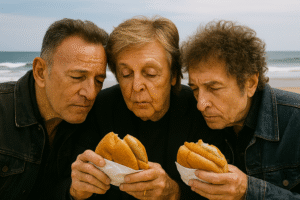
Bob raised an eyebrow. “And yet here you are.”
Bruce nodded. “Because I picked up my guitar again. And it answered back.”
The wind picked up. A family passed behind them, the father doing a double take—but deciding not to interrupt.
For a few minutes, no one said anything. They just sat, chewing slowly, listening to the old boardwalk creak behind them and the waves say what the world often forgot: time moves forward, but it never lets go.
Then Bruce pulled out a tiny pocketknife, the kind with a pencil sharpener blade. “You ever sign something,” he asked, “not for fame, but so a piece of you stays behind?”
He handed it to Dylan. Without a word, Bob carved a name—his real one: Robert. Then Paul: Paul M. Bruce added the last one, just: Bruce.
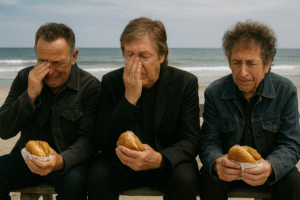
None of them spoke again. They stood. Looked once more at the sea. And walked off without fanfare.
Two months later, city workers returned to the bench. They’d received a quiet letter, unsigned, requesting a small glass canopy be installed over it. When they arrived, they noticed the carvings.
Someone whispered, “Are these real?”
Another said, “They were here together?”
No one had a photo. No one had proof. Just the marks in the wood.
But the town responded.
A plaque was placed below the glass:
“For the Words That Never Left.”
And people came.
Songwriters sat on the sand nearby, scribbling in notebooks. Old fans brought vinyl records and left them like flowers. Children ran past, not knowing the magic, but feeling it just the same.
Some say on foggy mornings, if you sit quiet enough, you can hear a soft hum behind the waves—a guitar, a harmonica, a soft Liverpool accent telling a story.
But that’s just legend.
What’s real is the bench.
And three names.
Etched into wood.
Still holding tight to the sea.