There are moments when music steps aside and something far more fragile takes its place. One such moment unfolded when Robin-John Gibb, Ashley Gibb, and Stephen Gibb stepped forward together to honor the men who shaped not only their lives, but the emotional language of generations. The arena did not brace for a performance. It leaned into silence, sensing that what was coming belonged to memory rather than stagecraft.
Their voices trembled — not from uncertainty, but from weight. Each word carried lineage. Each pause carried restraint. They did not speak as representatives of a famous name. They spoke as children and kin, shaped by fathers whose harmonies once moved the world. In their expressions, the audience saw courage — the courage to stand where history looms large and speak anyway.
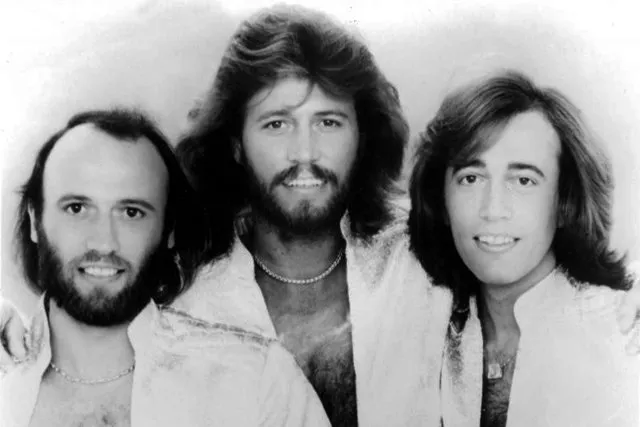
As they honored their fathers, the legacy of the Bee Gees hovered gently in the background, not as spectacle, but as presence. This was not a recitation of achievements. It was an offering of gratitude and remembrance, delivered with voices that wavered because they mattered.
Then the room shifted.
Barry Gibb appeared — not to speak, not to perform, but to listen.
He stood quietly, shoulders still, eyes fixed on the faces before him. And as his sons and nephews carried forward the story, the tears came without resistance. They were not dramatic. They were inevitable. Tears shaped by decades of shared life, by loss carried privately, and by the profound realization that what had once been held by three brothers was now being held by the next generation.
The arena froze.
No applause rose to interrupt the moment. No movement broke the stillness. The quiet sobs that echoed through the crowd were not noise; they were recognition. Recognition that legacy is not a museum piece. It is something alive, fragile, and entrusted.
For a mature and reflective audience, the power of this moment lay in its restraint. Barry Gibb did not attempt to steady himself for the room. He did not hide what he felt. He allowed it to be seen — a rare act of openness from a man who has carried so much with composure. His tears did not ask for sympathy. They asked for silence. And the silence answered.
Stephen Gibb stood with a steadiness shaped by inheritance and choice. Ashley Gibb’s expression carried tenderness and resolve. Robin-John Gibb’s presence bridged past and present with quiet dignity. Together, they did not recreate history. They continued it — not by imitation, but by truth.
This was not a moment about perfection. It was about continuity. About understanding that what endures is not only sound, but values: care, humility, listening, and the courage to feel deeply in public. The Bee Gees’ legacy has always been described in terms of harmony, but harmony is not sameness. It is balance. It is knowing when to speak and when to hold space.
Barry Gibb’s stillness said everything. In watching the next generation speak, he witnessed something no chart or accolade could ever offer: assurance. Assurance that the music was never only his to carry. Assurance that it had found new hands, new voices, and new hearts — all shaped by love rather than obligation.
When the moment finally released its hold, applause arrived softly, almost apologetically. It was not celebration. It was acknowledgment. The kind reserved for truths that feel too delicate to disturb.
Those who were present would later struggle to describe what they felt. Some spoke of heaviness. Others of calm. Many of gratitude. All agreed on one thing: time had paused, not because something ended, but because something passed on.
In the end, this tribute was not defined by words or sound. It was defined by presence — by sons and nephews stepping forward with honesty, and by a father standing still, allowing love and loss to share the same space.
The music did not play in that moment.
And yet, everything the Bee Gees ever stood for was there.
Time did not move.
It listened.