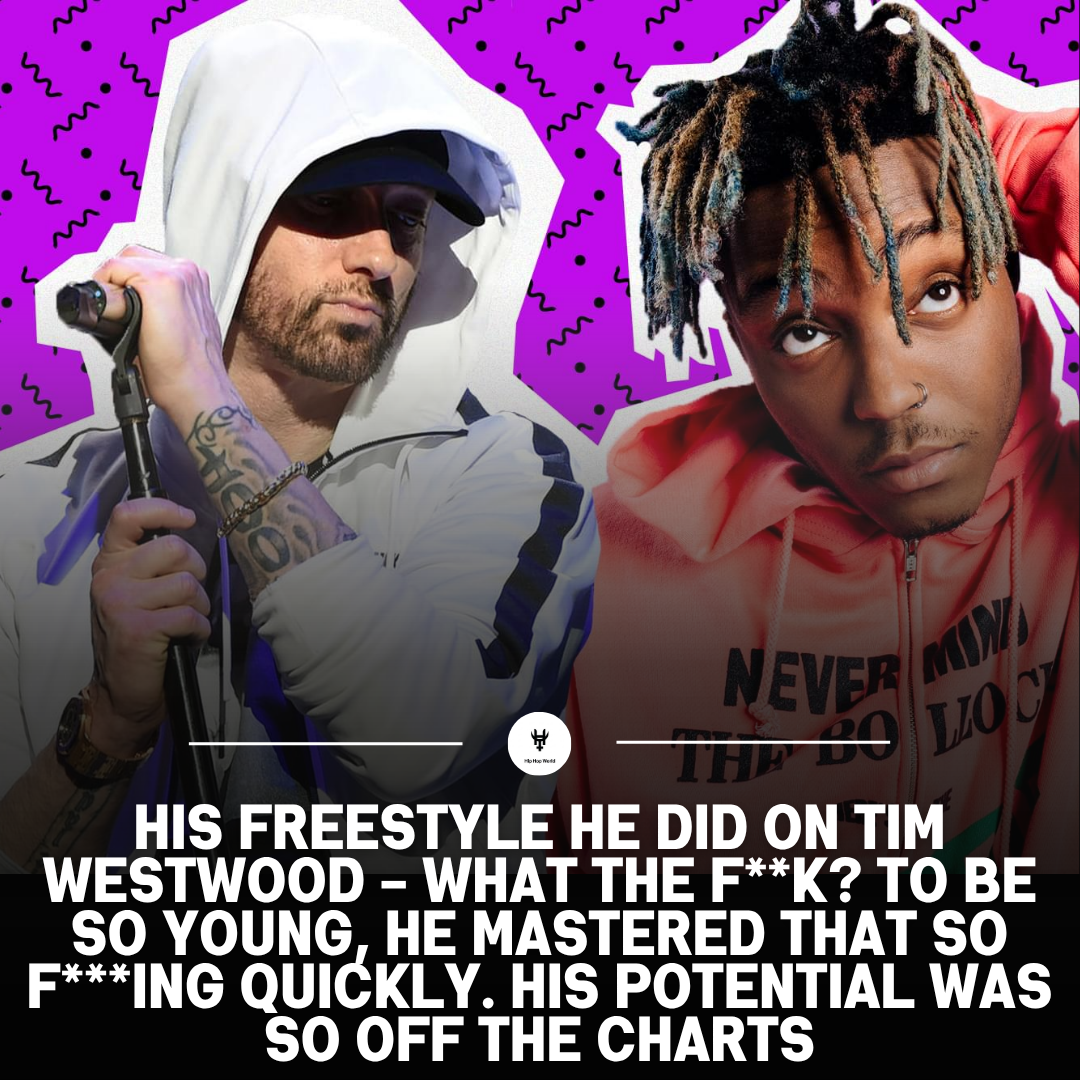
When Eminem talks about freestyle rap, it isn’t casual admiration. It’s recognition from someone who built his entire career on thinking faster than the beat.
Long before the fame, before The Slim Shady LP changed everything, his breakthrough came from moments where nothing was written. Battles, cyphers, the Rap Olympics—that’s where he proved himself. That’s how he got noticed by Dr. Dre. Freestyle wasn’t just a skill. It was the foundation.
So when someone new comes along and impresses him, it carries weight.
That’s exactly what happened when he saw Juice WRLD.
A Talent That Didn’t Feel Normal
Juice WRLD didn’t approach freestyling like most rappers. There was no visible effort, no pause to think. Words just kept coming—clean, structured, connected. Interviews turned into performances. A beat would drop, and he’d go… sometimes for minutes, sometimes much longer.
One of those moments stood out more than the rest.
During a session with Tim Westwood, Juice didn’t just freestyle—he sustained it. Nearly an hour of continuous bars, flowing over beats tied to Eminem’s own catalog. No resets. No breaks. Just consistency at a level that didn’t feel realistic.
Eminem saw it.
And it stayed with him.
From Respect to Collaboration
At that point, the reaction wasn’t just appreciation. It turned into action.
Eminem reached out. The result was Godzilla—a track built on speed, control, and precision. It wasn’t just a collaboration. It was a moment where two different generations met on the same wavelength.
But by the time the song fully landed, something had already changed.
Juice WRLD was gone.
At just 21, his life ended after a cardiac arrest linked to prescription drug use at Chicago’s Midway Airport. The momentum he had built—rapid, explosive, still growing—stopped without warning.
The video for Godzilla, released after his passing, closes on a different kind of moment. Not a performance. Not a flex. Just his voice:
“I hope everybody’s having a good day. I hope everybody accomplished something significant. Even if you didn’t accomplish anything significant, don’t be discouraged.
Just aim to accomplish something significant tomorrow, and the next day, and so on. If anybody’s going through anything, I hope and I pray that you get through it, and just know that you do have the strength to get through whatever the f**k you’re going through, no matter what it is.”
It doesn’t sound like someone at the peak of a rise. It sounds like someone trying to hold onto something deeper.
What Eminem Saw
A year later, speaking on Crook’s Corner with Crooked I, Eminem didn’t hesitate when describing him:
“That kid was so talented. Like his freestyle, he did on Tim Westwood — what the fuck? To be so young, he mastered that so f***ing quickly. His potential was so off the charts.”
There’s no exaggeration in that. No performance.
Just recognition.
Because Eminem understands what it takes to reach that level—and how rare it is to get there that fast.
The Part That Didn’t Get Finished
Juice WRLD’s rise wasn’t theoretical. It was already happening. The numbers, the reach, the consistency—it all pointed in one direction.
Even years after his passing, his music continues to hold its place, with millions still listening, still discovering, still replaying those same moments where everything felt effortless.
But the question around him never really changed.
Not what he did.
What he would have done next.
Because for someone who had already reached that level of control—especially in something as unpredictable as freestyle—it didn’t feel like he was close to the limit.
It felt like he had just started pushing it.
And that’s the part that stays unfinished.