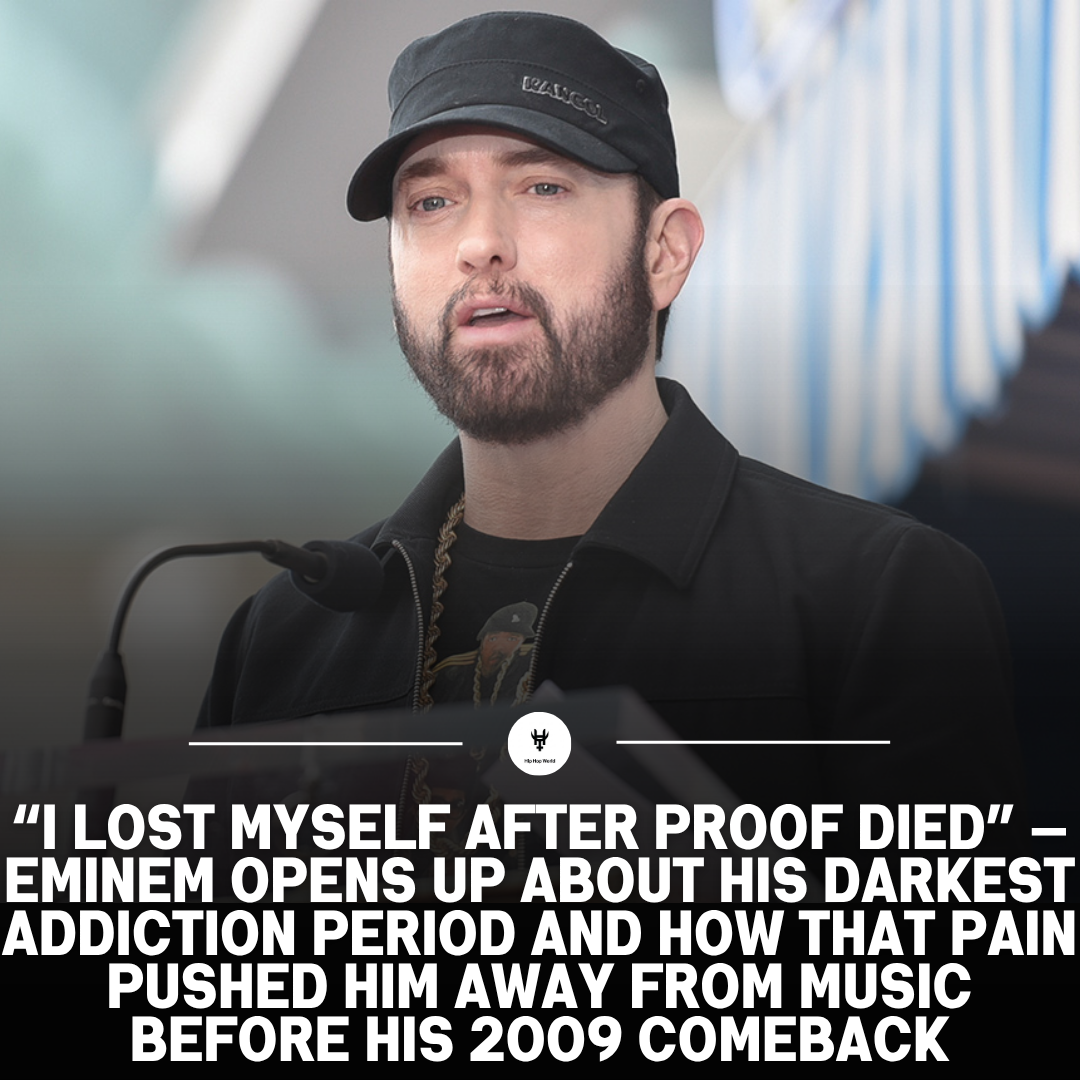
By the time Eminem reached 2004, the climb was already complete.
Three albums had reshaped hip-hop in rapid succession. The Slim Shady LP introduced chaos with precision. The Marshall Mathers LP amplified it into something cultural and unavoidable. The Eminem Show balanced introspection with dominance. Even beyond music, 8 Mile turned his story into a global narrative. Everything pointed upward.
And then came Encore.
The Moment Things Shifted
At first glance, Encore didn’t look like a collapse. It still sold. It still carried moments of sharp writing and familiar aggression. But something underneath had changed. The focus wasn’t as tight. The hunger didn’t feel the same. There were flashes of brilliance, but they were surrounded by uneven execution.
It wasn’t a dramatic fall. It was quieter than that.
The kind of shift you only notice when you look back.
Behind the scenes, things were already unstable. Eminem was dealing with addiction, and it was starting to affect not just his life—but his ability to create. The precision that once defined his work began to blur. Writing became harder. Clarity started slipping.
And eventually, he stepped away.
Silence, Loss, and a Darker Descent
What followed wasn’t just a break—it was a disappearance.
For five years, there were no new albums. No real sense of direction. Just distance.
Then came something heavier than writer’s block. His close friend Proof was shot and killed. The loss hit deeper than anything the public had seen from him before. It didn’t just shake him—it pushed him further into the very habits he was already struggling with.
He later admitted to XXL that Proof’s death forced him “into such a dark place… with everything, the drugs, my thoughts, everything.”
There was no performance in that statement. No exaggeration. Just a clear acknowledgment of how far things had gone.
At that point, the comeback wasn’t guaranteed. It wasn’t even expected.
The Return No One Fully Understood
By 2009, something had shifted again.
This time, quietly in the other direction.
Eminem had started rebuilding. Not publicly, not dramatically—but deliberately. He worked through the addiction. He pushed through the block. And slowly, the writing came back.
When he returned, he didn’t frame it as survival. He framed it as intent.
While promoting Relapse, he spoke with a kind of controlled intensity. He told Rolling Stone he was “running a lot,” adding that he had become “a little obsessive compulsive about running and the treadmill.” It wasn’t just about fitness—it was about discipline. Structure. Control.
Then he said something even more direct: “Hip-hop will be in a great place, because I am back.”
It sounded confident. Maybe even arrogant.
But it wasn’t casual.
A Complicated Comeback
When Relapse dropped on May 15, 2009, the reaction wasn’t simple.
The production stood out immediately—dark, layered, and technically sharp. But the accents he used throughout the album became a point of division. Some listeners couldn’t get past them. Others saw it as part of a larger creative risk.
For a while, the album sat in an uncertain space. Not rejected, but not fully embraced either.
Over time, though, that perspective softened. Listeners began to separate the surface choices from the deeper craftsmanship. The writing, the structure, the production—it all held up better than initial reactions suggested.
What once felt confusing started to feel deliberate.
What Actually Changed
The real shift wasn’t just the music. It was consistency.
After Relapse, Eminem didn’t disappear again.
Albums followed in 2010, 2013, 2017, 2018, 2020, and 2024. There were pauses, but nothing close to the silence that came after Encore. The long gap—the uncertainty—it never repeated.
That matters more than any single project.
Because the break between Encore and Relapse wasn’t just a pause in output. It was a moment where everything could have ended quietly. No announcement. No closure. Just absence.
Instead, it became a reset.
The End of One Era—and the Start of Another
Looking back, Encore wasn’t just another album in his catalog.
It was the end of a phase built on momentum, chaos, and near-constant output. Everything after it had to be rebuilt—health, discipline, creativity, purpose.
And Relapse wasn’t just a comeback album.
It was proof that he could come back at all.
When he said in 2009 that he was back, it wasn’t just about music. It was about control. About stability. About proving that the version of himself that made those early records hadn’t disappeared—just been buried.
And this time, he didn’t vanish again.