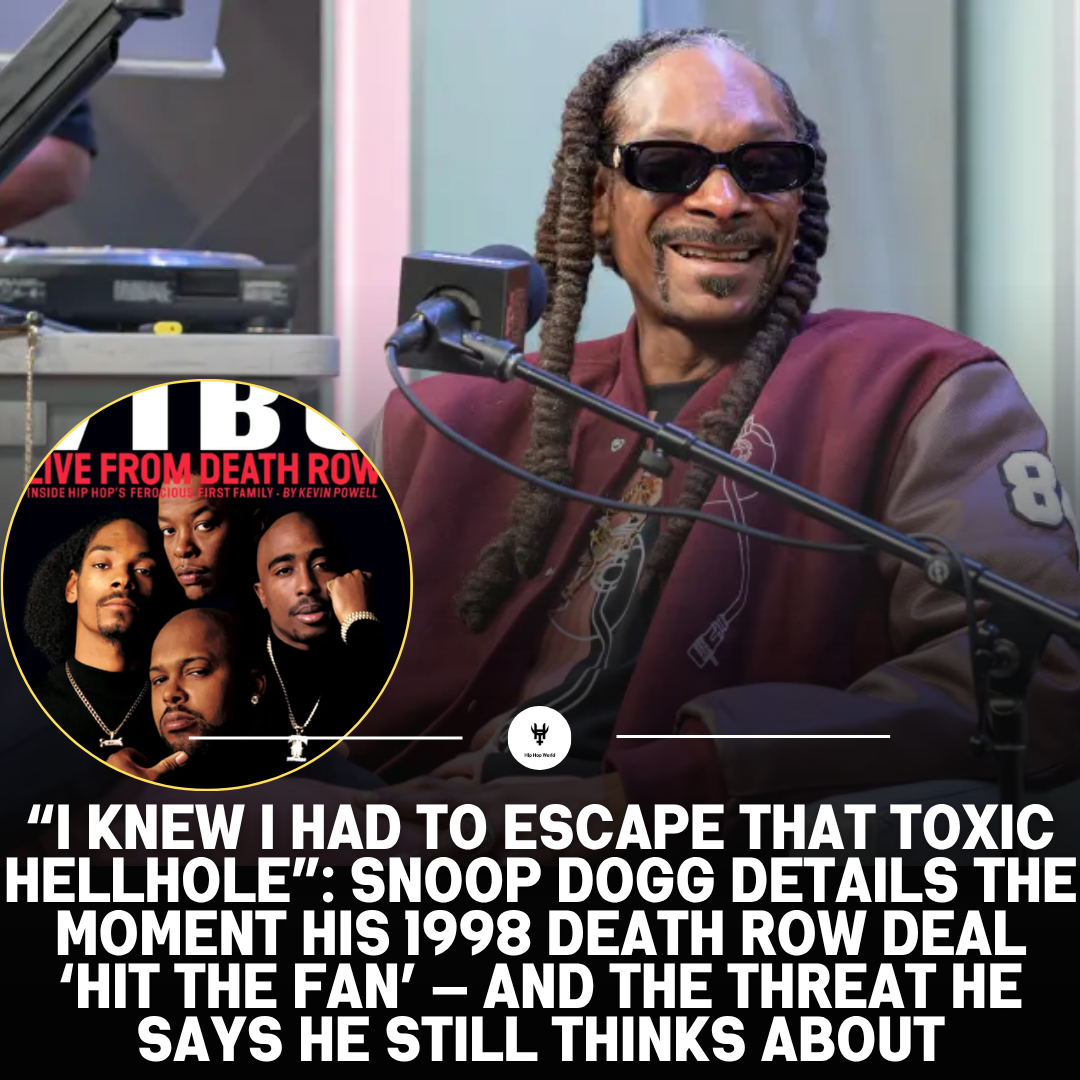
By the late 1990s, everything around Snoop Dogg was changing—and not in a way that felt controlled.
The success was still there. His voice remained one of the most recognizable in hip-hop, his presence still tied to the identity of West Coast rap. But behind that image, the environment he was working in had begun to shift into something far less stable. What once felt like momentum now carried a different kind of energy—tense, unpredictable, and increasingly difficult to ignore.
A Crumbling Empire
That shift traced back to Death Row Records, a label that had once stood at the center of hip-hop’s power structure. Under Suge Knight, it had built a legacy through dominant releases and larger-than-life personalities. But after the loss of Tupac Shakur in 1996, something fundamental changed.
Tupac’s death didn’t just remove an artist—it disrupted the balance of the entire operation. Soon after, Suge Knight’s legal troubles led to his imprisonment, leaving a leadership vacuum that no one could truly fill. Without that central force, the structure began to weaken.
Inside the label, tensions grew. Business decisions became inconsistent. The reputation that once attracted talent started to shift into something more volatile. For those still inside, it no longer felt like a place focused purely on music.
Caught in the Middle
Snoop wasn’t just another artist on the roster—he had been one of its defining faces. He had witnessed the rise of Death Row from the inside, and because of that, he also felt the weight of its decline more directly.
What had once been a creative environment began to feel uncertain. Reports of internal conflict and growing instability weren’t just distant stories anymore—they were part of the reality he was navigating day to day. The risk wasn’t abstract. It was personal.
At some point, the question shifted. It was no longer about loyalty or legacy. It became about whether staying made sense at all.
The Decision That Changed Everything
In 1998, Snoop made a move that would reshape his career.
He left Death Row Records and signed with No Limit Records, led by Master P. On paper, it looked like a business transition. In reality, it came with a significant cost.
Walking away meant giving up ownership tied to his earlier work, including his master recordings—assets that held both financial value and long-term control. For many artists, that kind of sacrifice would have been difficult to accept.
But for Snoop, the equation had changed. What he was leaving behind had become unpredictable enough that holding onto those benefits no longer felt worth it.
A Different System, A Different Direction
At No Limit, the environment was different. The focus shifted toward independence, output, and rebuilding. The sound of his music evolved during this period, but the more important shift wasn’t in the studio—it was in the structure around him.
For the first time in a while, there was a sense of stability again.
That change allowed Snoop to reset—not just creatively, but mentally. He was no longer operating inside a system that felt uncertain. Instead, he had space to move forward on his own terms.
Knowing When to Leave
Looking back, the decision stands as one of the most defining moments of his career.
It wasn’t driven by headlines or public statements. It came from something quieter—recognizing when an environment that once built you is no longer sustainable. In an industry where loyalty is often expected to outweigh everything else, Snoop chose a different path.
Not because it was easy. But because staying had become harder.