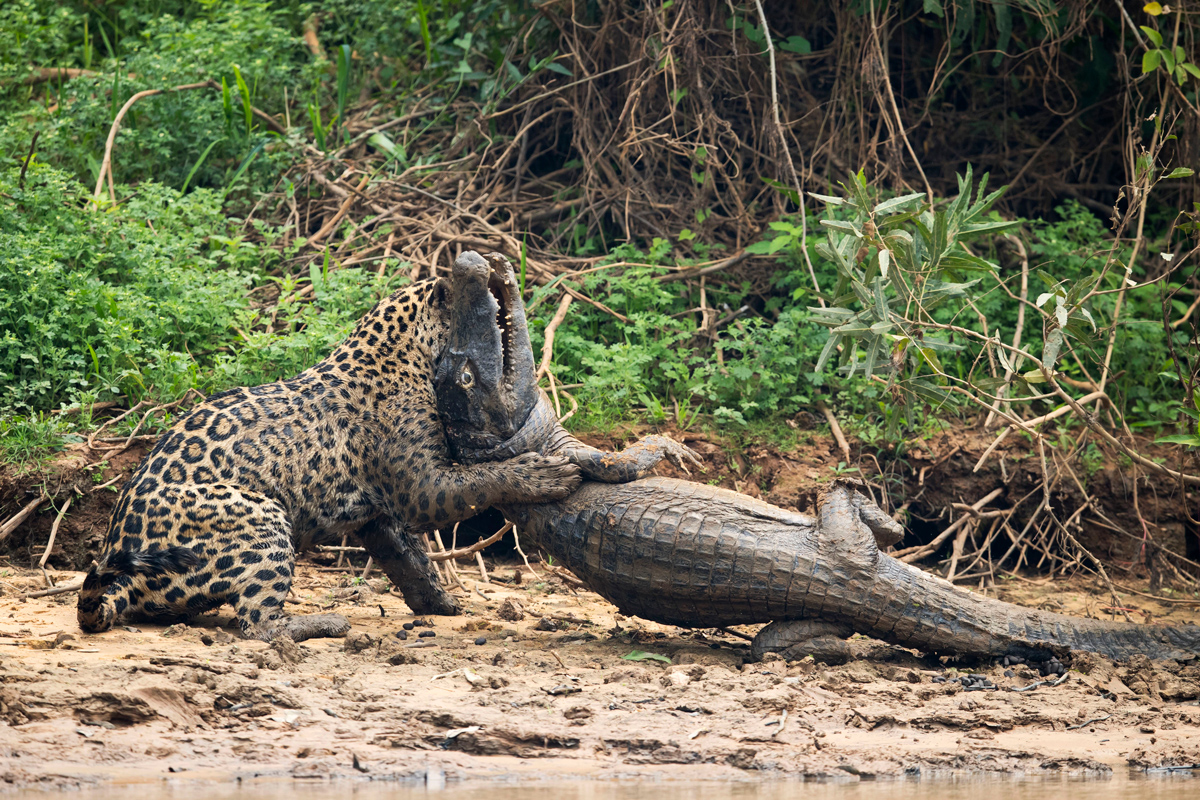
Deep within the wetlands and forests of South America, two remarkable predators share the same territory.
One is the caiman, an armoured reptile that has inherited millions of years of evolutionary adaptations.
The other is the jaguar, a muscular big cat possessing extraordinary strength and a remarkable ability to survive in aquatic environments.
While many terrestrial predators avoid large reptiles, jaguars have become exceptionally capable of hunting them.
Their relationship represents one of the most fascinating predator-prey encounters in the natural world.
Meet the Jaguar
The jaguar, scientifically known as Panthera onca, is the largest native cat in the Americas.
It is also the third-largest living cat species in the world, after the tiger and lion.
Jaguars inhabit a variety of environments, including tropical rainforests, wetlands, grasslands and seasonally flooded landscapes.
Their distinctive spotted coats provide excellent camouflage, while their muscular bodies make them powerful predators.
Unlike many domestic cats, jaguars are comfortable around water and are exceptionally capable swimmers.
This characteristic gives them access to a wide variety of prey that other terrestrial predators may find difficult to reach.
What Is a Caiman?
Caimans belong to the crocodilian family Alligatoridae, which also includes alligators.
Several species inhabit Central and South America, ranging from relatively small dwarf caimans to the enormous black caiman.
They possess protective scales, powerful jaws and sophisticated adaptations for aquatic hunting.
Depending on their species and size, caimans consume fish, birds, reptiles and mammals.
Although they are formidable predators in their own right, smaller and medium-sized caimans can become prey for jaguars.
The Jaguar’s Extraordinary Bite
One of the jaguar’s most remarkable characteristics is its powerful bite relative to its body size.
Its robust skull, muscular jaws and strong teeth allow it to consume prey with unusually tough protective structures.
Jaguars are known to feed on turtles, armadillos and crocodilians, demonstrating their ability to exploit food sources that can be challenging for other large cats.
This adaptation contributes to their exceptionally varied diet.
However, bite-force comparisons between species depend on how researchers estimate or measure strength. Popular claims that a jaguar has the strongest bite of every big cat should therefore be understood in context.
Why Jaguars Are So Comfortable in Water
Unlike the popular stereotype that cats dislike water, jaguars frequently inhabit environments where rivers and wetlands dominate the landscape.
They can cross waterways, travel through flooded forests and search for prey in aquatic habitats.
These abilities are especially important in Brazil’s Pantanal, one of the world’s largest tropical wetland systems.
Seasonal flooding transforms the landscape and influences the movement of both predators and prey.
Jaguars that inhabit these environments have access to an abundance of aquatic and semi-aquatic animals.
The Pantanal: Where Jaguars and Caimans Meet
Brazil’s Pantanal is internationally recognised for its remarkable biodiversity.
It supports substantial populations of caimans, capybaras, fish, birds and numerous other species.
Jaguars living in the region have been observed consuming caimans regularly.
In some areas, aquatic prey represents a particularly important part of their diet.
The availability of these animals helps explain why the Pantanal supports significant jaguar populations and provides exceptional opportunities for wildlife researchers and photographers.
Are All Caimans Vulnerable to Jaguars?
Caimans vary considerably in size.
While smaller species and younger individuals may represent suitable prey, exceptionally large adult black caimans can be dangerous opponents.
The relationship between jaguars and caimans therefore depends heavily on the species and size of the animals involved.
It would be inaccurate to suggest that a jaguar can effortlessly overpower every crocodilian it encounters.
Both predators possess remarkable physical abilities, and wildlife encounters are rarely predictable.
Why Jaguars Have Such a Varied Diet
Jaguars are opportunistic carnivores.
Their diets can include deer, peccaries, capybaras, reptiles, fish and numerous other animals.
This flexibility allows them to survive in environments where the availability of different prey species changes throughout the year.
In flooded landscapes, aquatic prey can become particularly important.
Their adaptability is one reason jaguars occupy such a wide range of habitats across the Americas.
Why Both Predators Matter
Jaguars and caimans play important roles in maintaining ecological balance.
Their presence influences prey populations and the behaviour of other animals within their habitats.
However, jaguars face significant threats from habitat loss, human-wildlife conflict and declining prey availability.
Protecting wetlands and forests benefits both species and the numerous other animals that depend on these ecosystems.
Final Thoughts
The jaguar’s ability to hunt caimans demonstrates the extraordinary diversity of adaptations found among big cats.
Its powerful jaws, muscular body and exceptional swimming abilities allow it to thrive in environments where land and water constantly interact.
The caiman remains a formidable predator, but its relationship with the jaguar illustrates how even highly specialised hunters can become prey.
Follow Wildlife Clash for more extraordinary predator encounters and fascinating discoveries from the animal kingdom.