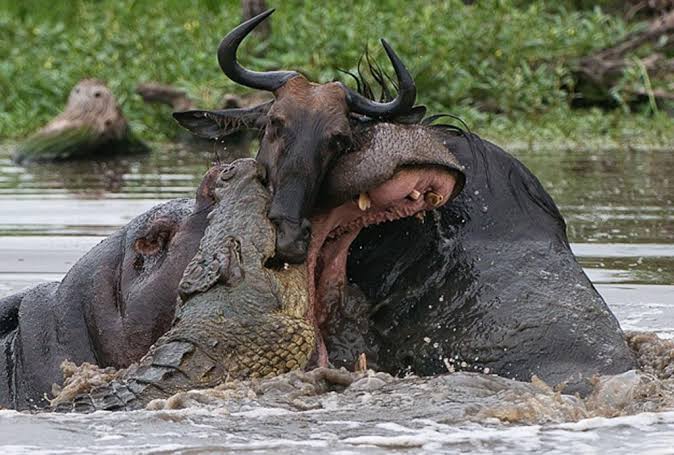
Beneath the surface of Africa’s rivers and lakes lives one of the world’s most formidable reptiles: the Nile crocodile.
With powerful jaws, exceptional patience and a remarkable evolutionary history, it is capable of hunting a wide variety of animals.
Yet another enormous creature regularly occupies the same waters without becoming its usual prey.
The hippopotamus is primarily a plant-eating mammal, but its size, strength and territorial behaviour make it one of the most intimidating animals in Africa.
Why do crocodiles generally avoid confronting healthy adult hippos?
Meet the Nile Crocodile
The Nile crocodile is one of the largest crocodilian species in the world.
Large adult males can exceed five metres in length and weigh several hundred kilograms.
Crocodiles possess exceptional adaptations for aquatic life. Their eyes and nostrils are positioned near the top of their heads, allowing them to remain largely submerged while observing their surroundings.
Their muscular bodies, powerful tails and protective scales make them remarkably successful predators.
However, even an animal with these impressive characteristics must consider the risks associated with confronting exceptionally large mammals.
The Hippopotamus: A Surprisingly Powerful Herbivore
Adult common hippopotamuses typically weigh well over a tonne, with some large males exceeding three tonnes.
Despite their rounded appearance, hippos are muscular animals capable of moving surprisingly quickly over short distances.
They possess enormous jaws and impressive canine teeth, which play important roles in defence and competition between individuals.
Unlike crocodiles, hippos primarily consume vegetation.
Their formidable physical characteristics are not adaptations for hunting large prey but for protecting themselves and competing for access to territory and other resources.
Why Crocodiles Avoid Healthy Adult Hippos
For a predator, survival depends partly on choosing prey that offers a reasonable balance between energy gained and risk of injury.
A healthy adult hippopotamus represents an exceptionally difficult and dangerous potential target.
Its enormous body mass and powerful defensive abilities make confrontation risky, even for a large crocodile.
An injured predator may struggle to hunt successfully afterwards, potentially threatening its long-term survival.
Crocodiles can therefore benefit from concentrating on smaller or more vulnerable animals rather than confronting healthy adult hippos.
This does not mean crocodiles are incapable of harming hippos. Young, injured or weakened individuals can be more vulnerable.
How Two Powerful Animals Share the Same Territory
Crocodiles and hippopotamuses are frequently found in the same rivers, lakes and wetlands.
Although their habitats overlap, their diets are substantially different.
Crocodiles are carnivores, while hippos primarily leave the water to graze on grasses.
This reduces direct competition for food.
In many environments, the two species coexist without constant confrontation.
Their relationship demonstrates that powerful animals do not necessarily need to fight simply because they occupy the same territory.
Why Hippos Spend So Much Time in Water
Hippos spend much of the day submerged to regulate their body temperature and protect their sensitive skin from prolonged exposure to sunlight.
Although they appear to swim effortlessly, hippos often move through deeper water by pushing themselves along the bottom.
They can remain submerged for several minutes before returning to the surface to breathe.
At night, they commonly leave the water to search for vegetation.
Their dependence on aquatic habitats brings them into regular proximity with crocodiles.
Are Baby Hippos Safe Around Crocodiles?
Young hippos are considerably more vulnerable than fully grown adults.
Their smaller size makes them potential prey for large crocodiles and other predators.
Adult hippos, particularly mothers, can display strong protective behaviour around their offspring.
However, not every encounter between a crocodile and a young hippo results in an attack.
The circumstances of each encounter, including the presence of protective adults, influence the level of danger.
The Surprising Importance of Hippos to River Ecosystems
Hippos play an important ecological role by transferring nutrients between terrestrial and aquatic environments.
They consume vegetation on land and release organic material into rivers and lakes.
These nutrients can support aquatic food webs, although excessive concentrations under certain conditions can also reduce oxygen levels and harm aquatic life.
Crocodiles likewise influence ecosystems through their roles as predators and scavengers.
Together, these remarkable animals help shape some of Africa’s most complex freshwater environments.
Crocodile vs Hippopotamus: Who Would Win?
There is no universal outcome to every wildlife encounter.
However, a healthy adult hippopotamus possesses a substantial size advantage over most Nile crocodiles.
Its physical strength and defensive capabilities make it a particularly risky opponent.
Crocodiles remain extraordinarily successful predators, but avoiding unnecessary confrontation is itself an effective survival strategy.
Final Thoughts
The relationship between crocodiles and hippos reveals why nature’s most powerful animals do not always seek confrontation.
Even formidable predators must recognise when the risks outweigh the rewards.
The hippopotamus demonstrates that an animal does not need to be a carnivore to command respect within the natural world.
Follow Wildlife Clash for more incredible wildlife encounters, surprising animal facts and extraordinary survival stories.