Brooks & Dunn were supposed to be the center of a celebration honoring more than three decades of country music history. Instead, their tribute at the 2026 CMA Awards sparked an unexpected debate about what it really means to honor a legendary artist.
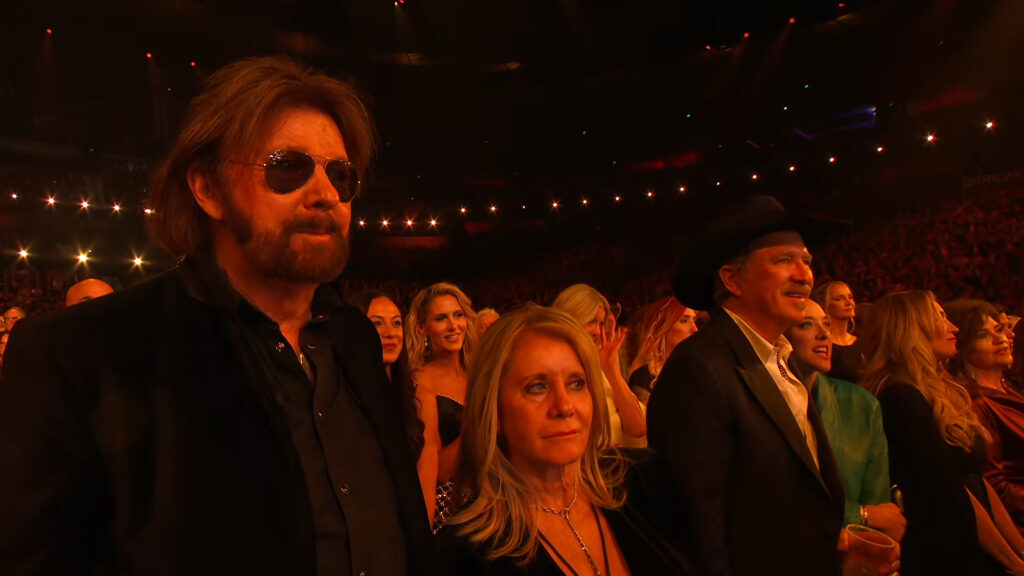
As Halestorm launched into a hard-rock interpretation of “Boot Scootin’ Boogie,” cameras captured Ronnie Dunn, Kix Brooks, and members of their party watching from the audience. Viewers quickly began examining their expressions, with some suggesting that Dunn and his wife looked less than enthusiastic about the performance.
The reaction became part of a much larger conversation about the musical direction of the tribute.
Some fans believed the rock-heavy arrangements were a creative way to celebrate Brooks & Dunn’s influence. Others questioned why a duo so closely associated with traditional country music was being honored with performances that sounded so different from their original recordings.
But there was an important detail missing from some of the criticism: Brooks & Dunn had already collaborated with Halestorm on a previous project.
That connection complicates the idea that the rock band’s appearance was an unexpected departure from the duo’s musical preferences.
The tribute took place during the 60th Annual CMA Awards on November 18, 2026, before Brooks & Dunn received the Willie Nelson Lifetime Achievement Award.
The honor recognized the duo’s remarkable career, including their influence on country music across multiple generations.
Kix Brooks and Ronnie Dunn have spent more than three decades building a catalogue of songs that helped define the genre during the 1990s and beyond.
Their combination of energetic performances, memorable songwriting, and distinctive vocal styles made them one of country music’s most successful partnerships.
They also hold the record for the most CMA Award wins, giving their lifetime achievement recognition particular significance.
A tribute to artists with that kind of history carries considerable expectations.
Fans often hope to hear familiar songs performed in ways that preserve the qualities that made the originals memorable.
For Brooks & Dunn, those expectations include traditional country instrumentation, recognizable melodies, and the distinctive energy associated with their recordings.
The CMA Awards tribute took a different approach.
Rather than relying exclusively on conventional country performers, the ceremony brought together musicians representing several styles.
Halestorm opened with “Boot Scootin’ Boogie,” one of Brooks & Dunn’s signature songs.
The original recording became closely associated with country line dancing and the commercial success of the genre during the early 1990s.
Halestorm’s version emphasized hard-rock instrumentation and Lzzy Hale’s powerful vocal delivery.
That contrast immediately became a subject of discussion.
One viewer argued that the people responsible for organizing the performance should lose their jobs, while another suggested that the duo deserved a tribute that better preserved country music’s traditional sound.
Other comments focused less on the musical arrangement and more on the expressions shown during audience reaction shots.
One person suggested that Dunn’s wife’s face revealed her opinion of the performance.
Another argued that the duo’s expressions communicated everything viewers needed to know.
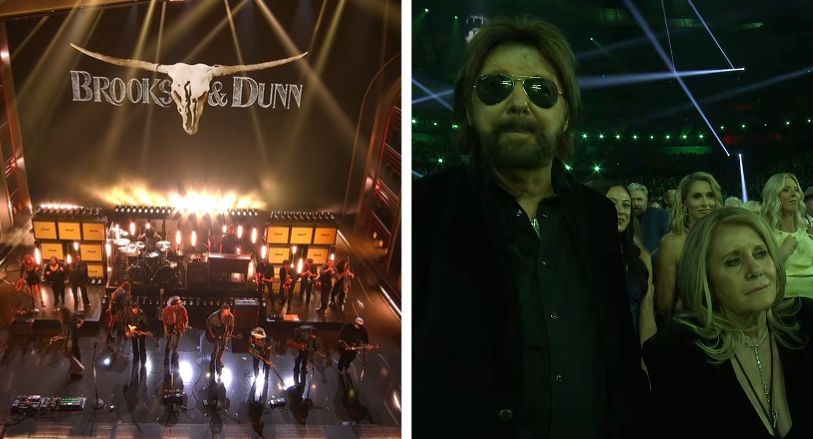
Those interpretations spread because televised awards ceremonies frequently cut between performers and the people being honored.
Reaction shots are designed to connect audiences with the emotional significance of a performance.
However, a brief facial expression does not necessarily reveal someone’s complete opinion.
A person may be concentrating on the music, responding to a particular moment, or simply watching without displaying an obvious reaction.
Without a direct statement, it is difficult to determine what Dunn, Brooks, or their family members were thinking.
That distinction is especially important when online commentary begins treating a few seconds of footage as definitive evidence of disapproval.
The supplied account does not include a statement from Dunn’s wife explaining her reaction.
It therefore would be misleading to conclude that she disliked the tribute based solely on viewers’ interpretations.
The same caution applies to the duo themselves.
While some fans believed Brooks and Dunn appeared uncomfortable, their expressions alone cannot establish whether they approved of the arrangements.
In fact, the history between Brooks & Dunn and Halestorm provides an important reason to question the assumption that the rock band’s involvement was unwelcome.
Halestorm appeared on Brooks & Dunn’s 2024 album Reboot II.

The project featured reinterpretations of the duo’s songs alongside artists from different musical backgrounds.
It followed the broader concept of revisiting familiar material through collaborations rather than simply reproducing the original recordings.
That creative approach demonstrated a willingness to experiment with how Brooks & Dunn’s catalogue could sound.
Halestorm’s participation in the album meant the band was not an entirely unfamiliar choice for the CMA tribute.
The connection does not prove that Brooks & Dunn personally selected the televised arrangement or approved every element of the performance.
But it does establish that the relationship between the artists existed before the ceremony.
Several viewers pointed out that history while defending the performance.
One encouraged critics to revisit Reboot II, arguing that Halestorm’s interpretation was consistent with music the duo had already released.
Another praised the rock band’s musicianship and Lzzy Hale’s abilities as a vocalist.
These responses highlighted a different way of understanding the tribute.
Rather than viewing the performance as an attempt to replace traditional country music with rock, supporters saw it as evidence that Brooks & Dunn’s songs could work across genres.
That interpretation fits the broader purpose of a lifetime achievement award.

Such honors recognize not only an artist’s commercial accomplishments but also the influence their work has had on other musicians.
When performers from different musical backgrounds reinterpret a song, they can demonstrate how far that influence extends.
However, artistic experimentation does not guarantee that every audience will enjoy the result.
The response to Halestorm illustrated that distinction.
Some viewers appreciated the unexpected energy, while others felt the arrangement moved too far away from the qualities they associated with “Boot Scootin’ Boogie.”
One critic said the tribute improved only when the more traditional country performances began.
Another described the opening as confusing because the rock vocals initially made the song difficult to recognize.
Those reactions were subjective judgments about the music, not evidence of how Brooks & Dunn themselves felt.
The tribute continued with several additional performances.
Marcus King performed “Rock My World (Little Country Girl),” bringing his blues-influenced style to the celebration.
Brothers Osborne followed with “Hard Workin’ Man,” while HARDY delivered “Hillbilly Deluxe.”
The sequence concluded with Luke Bryan and Brad Paisley performing “Play Something Country.”
That final selection created an especially ironic moment for some viewers.
After a tribute that had included prominent rock influences, the ceremony ended with a song whose title seemed to echo the complaints being made online.
Several fans noticed the contrast and joked about the choice.
For others, Bryan and Paisley’s performance provided the familiar country sound they had wanted throughout the tribute.
The disagreement revealed how differently audiences can interpret the same celebration.
Some listeners believe a tribute should remain faithful to an artist’s established musical identity.
Others prefer reinterpretations that demonstrate how the songs have influenced performers outside their original genre.
Neither approach is inherently incompatible with honoring a musical legacy.
The challenge is finding a balance that satisfies the artists being recognized while also creating an engaging television performance.
Brooks & Dunn’s career makes that balance particularly interesting.
Their music has long combined traditional country elements with energetic production and influences from other styles.
Songs such as “Boot Scootin’ Boogie” became enormous hits partly because they connected country music with broader audiences.
The duo’s continued willingness to revisit their catalogue through collaborative recordings suggests that experimentation has remained part of their professional identity.

At the same time, many longtime fans associate their music with a particular era and sound.
Those listeners may feel that changing the arrangements too dramatically risks losing the qualities that made the songs special.
The 2026 tribute brought those competing perspectives into direct conflict.
After the performances, Taylor Swift presented Brooks & Dunn with the Willie Nelson Lifetime Achievement Award.
The presentation shifted attention back to the duo’s career and their contribution to country music.
CMA CEO Sarah Trahern praised their role in shaping the genre over more than 30 years and influencing successive generations of performers.
That recognition was the central purpose of the evening.
The debate over individual performances should not obscure the significance of the award itself.
Brooks & Dunn’s longevity, commercial achievements, and influence have made them an essential part of modern country music history.
Their songs remain recognizable decades after their original releases, and their catalogue continues to attract artists interested in reinterpreting it.
The tribute demonstrated both the strength of that legacy and the challenges involved in celebrating it.
When music becomes closely connected to people’s memories, listeners can develop strong expectations about how it should be performed.
A radically different arrangement may feel exciting to one person and disappointing to another.
Neither response necessarily reflects a lack of respect for the original artists.
It may simply reveal what different audiences value most about the music.
The controversy also demonstrates the risks of interpreting celebrity reactions through short television clips.
A camera shot can become the basis for an entire narrative, even when the people shown have not explained what they were thinking.
In this case, viewers debated whether Dunn and his wife appeared unhappy, while the duo’s previous collaboration with Halestorm offered important context that complicated those assumptions.
The available reporting does not establish that Dunn’s wife objected to the performance.
Nor does it prove that Brooks & Dunn were offended by the musical choices.
Those conclusions would require clearer evidence than audience reaction shots and social media speculation.
What can be said is that the tribute divided viewers and generated a substantial discussion about country music traditions.
That discussion may ultimately reveal as much about the audience as it does about the performers.
For some fans, Brooks & Dunn represent a sound that should be preserved.
For others, their legacy is strong enough to support reinterpretation by musicians from different genres.
Both perspectives reflect the importance of the duo’s catalogue.
In my view, the most revealing aspect of the controversy is the contradiction between the criticism of Halestorm’s involvement and the fact that Brooks & Dunn had already welcomed the band into their musical world through Reboot II.
That history does not require fans to enjoy the performance.
But it does suggest that the tribute’s creative direction was not as disconnected from the duo’s recent work as some reactions implied.
The ceremony was intended to celebrate a partnership that helped shape country music for more than three decades.
Instead, it also became a conversation about how musical legacies should be interpreted for new audiences.
And perhaps that is an unavoidable part of honoring artists whose songs mean different things to different generations.
Brooks & Dunn received one of country music’s most prestigious lifetime achievement honors, while the performances surrounding it demonstrated that their catalogue still inspires strong opinions.
The question now is whether those differences should be seen as a problem or as evidence of the music’s lasting relevance.
When honoring country legends like Brooks & Dunn, should artists preserve the original sound as closely as possible, or should they be encouraged to reinvent classic songs in their own musical styles?