Deep beneath the freezing waters of the Arctic Ocean lives a mysterious creature that could have been swimming through the world’s oceans long before the United States was founded.
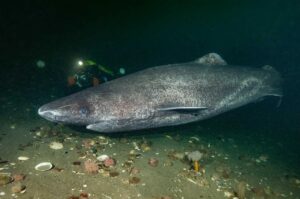
The Greenland shark is the longest-living vertebrate known to science, with an extraordinary lifespan that may exceed 400 years.
But how does this remarkable predator survive for centuries?
A Living Piece of History
In 2016, researchers used radiocarbon dating to examine proteins in the eye lenses of 28 Greenland sharks.
The largest shark studied was estimated to be approximately 392 years old, with an uncertainty of 120 years.
This means that some Greenland sharks alive today could have been born during the 17th century, long before electricity, aeroplanes or modern medicine.
The Secret Behind Its Extraordinary Lifespan
Greenland sharks inhabit the extremely cold waters of the Arctic and North Atlantic oceans.
Their slow metabolism, low activity levels and cold environment are believed to contribute to their remarkable longevity. Scientists are still investigating the precise biological mechanisms behind their slow ageing.
These sharks grow at an astonishingly slow rate, estimated at around one centimetre per year.
It Takes Around 150 Years to Reach Maturity
Perhaps even more astonishing is that female Greenland sharks are estimated to reach sexual maturity at around 150 years of age.
By the time one of these sharks is ready to reproduce, several generations of humans may have already lived and died.
A Mysterious Predator of the Deep
Greenland sharks can grow to more than six metres in length. Despite their enormous size, they move relatively slowly through the water.
Their diet includes fish, seals and animal remains. How they capture some of their faster prey remains a subject of scientific investigation.
Many Greenland sharks also carry parasites attached to their eyes, which can impair their vision.
Could This Shark Unlock the Secrets of Ageing?
Scientists continue to investigate Greenland sharks to better understand how their bodies function over such extraordinary lifespans.
Their unique biology could potentially provide valuable insights into ageing, cellular health and longevity.
For now, the Greenland shark remains one of nature’s greatest mysteries — a living witness to centuries of human history, silently roaming the darkest depths of our planet.