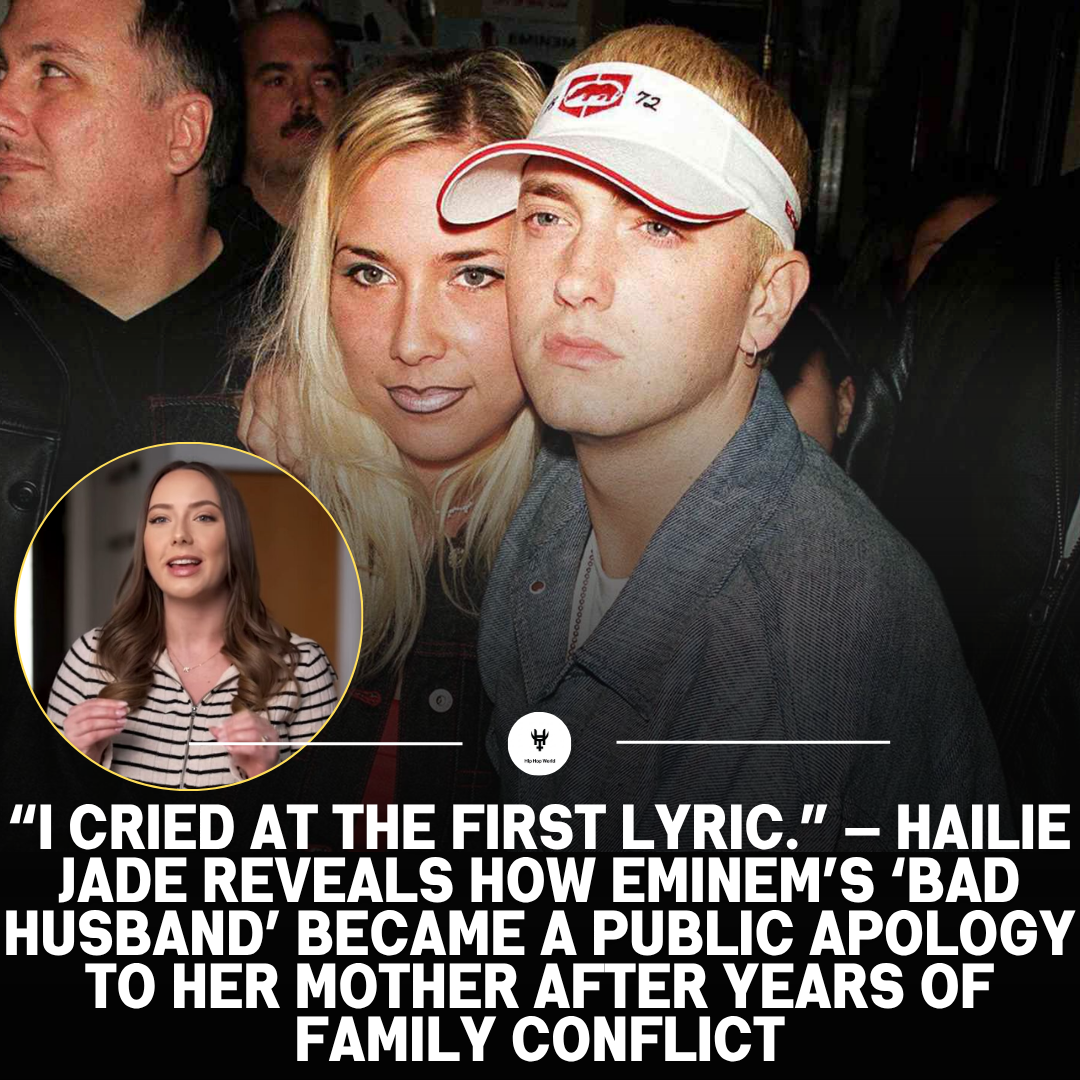
The first lyric hadn’t even finished when she broke down.
On an episode of Just a Little Shady, Hailie Jade described hearing “Bad Husband” for the first time—not as a fan, but as someone who understood exactly who it was for. The track, buried within Revival, wasn’t just another reflective record. It was something far more personal.
It was an apology.
A Different Kind of Song
For listeners, “Bad Husband” sounded like a quieter moment from Eminem—a step back from aggression into reflection. But inside the Mathers family, the context ran deeper. The lyrics were directed at Kim Scott, acknowledging years of conflict that had long been public.
He didn’t rewrite what happened. He didn’t soften it. He admitted it.
And that distinction mattered.
For nearly two decades, their relationship had existed in headlines, interviews, and verses—often amplified to millions. What had once been private had become part of Eminem’s identity as an artist. But this time, the tone shifted. There was no attack, no sarcasm, no performance.
Just accountability.
The Turning Point
Hailie didn’t describe it as surprising. She had heard apologies before. But this one felt different.
Because it couldn’t disappear.
It was recorded. Pressed. Released. Permanent.
Her father wasn’t just speaking to one person—he was saying it in front of the world. And in doing that, he changed something that had been stuck for years.
The reaction came instantly. The first line was enough.
Not because it explained everything. But because it didn’t try to.
After the Words
Growing up in that environment meant learning to live with two versions of the same story—the one the public knew, and the one that stayed inside the family. For most people, those songs were entertainment. For her, they were memories.
That’s what made this moment different.
It didn’t erase anything. It didn’t undo the past. But it shifted the direction of it. The energy changed—from defense to responsibility, from reaction to reflection.
And that created space.
Not closure all at once, but the beginning of it.
What Was Really Said
In Eminem’s career, music has always blurred into real life. It has been where he confronts things he doesn’t address anywhere else. With “Bad Husband,” that pattern stayed—but the purpose changed.
Instead of escalating conflict, he stepped back into it and spoke differently.
The setting was the same. The tone wasn’t.
For Kim, the message didn’t come through a conversation behind closed doors. It came through the same medium that once exposed everything. That choice carried its own meaning—meeting the past in the exact place it had been made public.
And this time, it didn’t escalate.
It settled.
The Quiet Shift
Hailie has always spoken carefully about both parents, never reducing their story to headlines. What stood out to her wasn’t just what was said—it was how it was said. Calm. Direct. Without the anger people had come to expect.
That absence changed the weight of the words.
Because growth, in that moment, wasn’t loud.
It was clear.
And for someone who had lived through both sides of that story, that clarity was enough to be felt immediately.
What Stayed Behind
Most people heard a song.
She heard something else.
Not a performance. Not a moment crafted for an audience. But a piece of something that had been unresolved for years, finally spoken in a way that didn’t add to the noise.
It didn’t fix everything.
But it opened something that had stayed closed for a long time.
And sometimes, that’s the part that matters most.