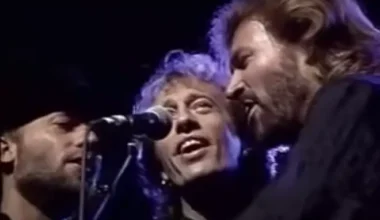
“I don’t know if I’ll ever feel this alive again.”
Some sentences become unforgettable because of when they are spoken.
For Ozzy Osbourne, those words carried the weight of an entire lifetime.
His final performance was never going to be just another concert.

It was a farewell.
A return home.
A final opportunity to stand before the people who had watched his journey from the beginning and remind the world why his voice had become one of the defining sounds of rock and heavy metal.
And when Ozzy finally faced that crowd in Birmingham, something extraordinary happened.
For one night, the years disappeared.
The health struggles disappeared.
The uncertainty disappeared.
There was only Ozzy, his music, his hometown, and tens of thousands of people who had come to say goodbye.
BACK WHERE THE STORY BEGAN
Birmingham was never simply another city in Ozzy Osbourne’s story.
It was home.
It was where John Michael Osbourne grew up.
It was where the foundations of Black Sabbath were laid.
And it was from this industrial English city that a group of musicians would eventually help change the sound of rock music forever.
Ozzy’s journey from Birmingham to international superstardom was almost impossible to imagine in the beginning.
Yet decades later, he returned to the city as one of the most recognizable figures rock music had ever produced.
The circle was closing.
The boy from Birmingham had become the Prince of Darkness.
And now the Prince of Darkness was coming home.
A FINAL NIGHT UNDER THE LIGHTS
By the time Ozzy took the stage, fans understood the significance of what they were witnessing.
This was not simply another appearance.
It was the final chapter of a performing career that had stretched across generations.
Years of serious health struggles had changed what Ozzy could physically do.
But the moment he faced the audience, something remained unmistakable.
His presence.
His voice.
His connection with the crowd.
The physical limitations could change the performance.
They could never erase the meaning of it.
The fans knew that.
Ozzy knew that.
And the emotion in the stadium reflected it.
THEN BIRMINGHAM ANSWERED
There is something powerful about hearing thousands of people sing the songs of an artist back to him.
Especially when those songs have followed them for decades.
When “Crazy Train” rang out, the audience didn’t simply listen.
They responded.
The voices of thousands joined together.
Then came “Paranoid.”
A song that had traveled from the early days of Black Sabbath into the lives of generations of listeners.
For a few moments, Ozzy wasn’t looking at the end of his career.
He was standing inside its entire history.
Every face in the crowd represented another piece of that journey.
Every voice singing the words represented another life touched by the music.
“YOU HAVE NO IDEA HOW I FEEL”
The emotion of the night was impossible to separate from Ozzy’s relationship with his audience.
He had spent decades performing for crowds around the world.
He had seen enormous stadiums.
He had experienced sold-out arenas.
He had heard fans scream his name in countless countries.
But there was something different about Birmingham.
This wasn’t simply an audience.
These were his people.
This was the city that had shaped him.
The city that had helped give birth to Black Sabbath.
The place where his story began before the world knew his name.
And when he looked out at that crowd, the emotion wasn’t simply coming from one side of the stage.
It was coming from everyone.
THE CROWD BECAME PART OF THE FAREWELL
The fans knew what the night meant.
They sang louder.
They celebrated harder.
They held onto every moment.
Some smiled.
Some cried.
Some simply stood there absorbing the fact that they were witnessing something they would remember for the rest of their lives.
Confetti filled the air.
The lights swept across the stadium.
The music continued.
But beneath all the spectacle was something deeply human.
A community saying goodbye to someone who had given them a soundtrack for their lives.
FROM BLACK SABBATH TO THE WORLD
Ozzy’s journey had begun with Black Sabbath.
Alongside Tony Iommi, Geezer Butler, and Bill Ward, he helped establish a sound that would become foundational to heavy metal.
The music was darker.
Heavier.
More intense.
It captured something that conventional rock had rarely expressed in quite the same way.
And Ozzy’s voice became inseparable from that sound.
His delivery wasn’t polished in the traditional sense.
It was distinctive.
Raw.
Unmistakable.
It carried emotion in a way that made the songs instantly recognizable.
The world eventually gave him a title:
The Prince of Darkness.
But before the title came the music.
And before the music came Birmingham.
THE MAN BEHIND THE MYTH
Over the decades, Ozzy became surrounded by mythology.
The costumes.
The stories.
The controversies.
The larger-than-life image.
The Prince of Darkness persona.
But moments like his final performance revealed something different.
The human being behind the legend.
A man standing before his hometown, knowing that this was the final time he would perform there in this way.
A musician looking out at people who had followed him through different chapters of his life.
A person experiencing the same mixture of gratitude, sadness, pride, and uncertainty that anyone might feel when reaching the end of an extraordinary journey.
The mythology could fill a stadium.
But the emotion belonged to Ozzy the person.
“BIRMINGHAM, YOU MADE ME WHO I AM”
Few artists can say that their hometown helped shape music history.
Ozzy could.
Birmingham wasn’t simply a location on his biography.
It was part of his identity.
It was part of the story behind Black Sabbath.
It was part of the accent in his voice, the experiences of his youth, and the culture from which his music emerged.
So returning there for his final performance gave the night a significance that another city could never quite duplicate.
He wasn’t merely performing in Birmingham.
He was coming home.
THE SONGS BECAME MEMORIES
When fans sang “Crazy Train,” they weren’t only singing a famous Ozzy song.
They were remembering.
They were remembering records played in bedrooms.
Concerts attended with friends.
Long drives.
Younger years.
First discoveries.
Family members who introduced them to the music.
Moments when an Ozzy song became attached to something personal.
That’s the strange power of music.
An artist creates a song.
But listeners turn that song into part of their own lives.
And when the artist performs it for the final time, thousands of personal memories can suddenly exist in one place.
THE FINAL ROAR
As the performance moved toward its conclusion, the atmosphere became increasingly emotional.
The crowd knew the night was ending.
Ozzy knew it too.
The music continued to provide the energy, but beneath it was an unmistakable sense of finality.
This was the last time.
The last stage.
The last roar from that hometown crowd.
The last opportunity to hear those songs performed by the man whose voice helped make them legendary.
And yet, the night didn’t feel defeated.
It felt celebratory.
Because Ozzy wasn’t leaving behind silence.
He was leaving behind music.
A LIFETIME IN ONE STADIUM
Think about what that final performance represented.
A boy from Birmingham.
A young musician discovering his voice.
The birth of Black Sabbath.
The rise of heavy metal.
The beginning of a solo career.
Randy Rhoads.
Zakk Wylde.
Albums.
Tours.
Stadiums.
Fans.
Family.
Struggles.
Comebacks.
Decades of music.
All of it led back to Birmingham.
All of it seemed to converge in one final performance.
That is why the night mattered.
It wasn’t simply the end of a concert.
It was the closing of a chapter that had been written over more than half a century.
THE PRINCE OF DARKNESS, AT HOME
Ozzy’s public image had always been larger than life.
But on that final stage, his greatest power came from something much simpler.
Connection.
He didn’t need to prove that he was still the same performer he had been decades earlier.
He didn’t need to turn back time.
He simply needed to stand before the people who loved his music.
And they met him there.
The fans didn’t come expecting perfection.
They came for Ozzy.
They came to hear the songs.
They came to celebrate the memories.
And most importantly, they came to say goodbye.
WHEN THE LIGHTS FINALLY FADE
Eventually, every concert ends.
The lights go down.
The equipment is packed away.
The crowd begins to leave.
But some concerts don’t really end when the final note disappears.
They become memories.
Stories people tell years later.
Photographs that become more meaningful with time.
Recordings that suddenly feel different because you know what came afterward.
Ozzy’s final performance became one of those nights.
For everyone who was there, it was something they could carry with them.
For everyone who wasn’t, the images and recordings became a way to experience a small part of the moment.
THE MUSIC WILL NOT SAY GOODBYE
Ozzy Osbourne eventually left the stage.
But his music didn’t leave with him.
“Paranoid” still sounds.
“Crazy Train” still plays.
Black Sabbath’s records still turn.
New generations still discover the songs.
Young musicians still pick up guitars because of the artists who came before them.
And somewhere, someone who has never seen Ozzy perform live is hearing his voice for the first time.
That is where the real power of a musical legacy exists.
Not simply in the past.
In the future.
BIRMINGHAM’S FINAL GIFT
Perhaps the most beautiful part of Ozzy’s final performance was that the farewell went both ways.
Ozzy gave Birmingham a lifetime of music.
And Birmingham gave Ozzy one final roar.
The city that helped make him who he was stood behind him one last time.
Tens of thousands of voices became one.
They sang his songs.
They celebrated his life.
They reminded him that the music had mattered.
And when the final notes disappeared into the night, the relationship between Ozzy and his hometown didn’t end.
It became history.
THANK YOU, OZZY
Ozzy Osbourne spent his life making music that refused to behave.
He helped create heavy metal.
He became one of rock’s most recognizable voices.
He inspired generations of musicians.
He gave millions of fans songs that became part of their lives.
And when the time came for his final performance, he didn’t simply disappear quietly.
He stood before his hometown.
He looked out at the people.
And Birmingham answered with everything it had.
The Prince of Darkness may have left the stage.
But the stage was never the only place where Ozzy existed.
He lives in the records.
He lives in the riffs.
He lives in the voices of fans singing along.
He lives in the musicians he inspired.
He lives in Birmingham.
And he lives in every person who hears one of his songs and feels something stir inside them.
The final performance ended.
The music didn’t.