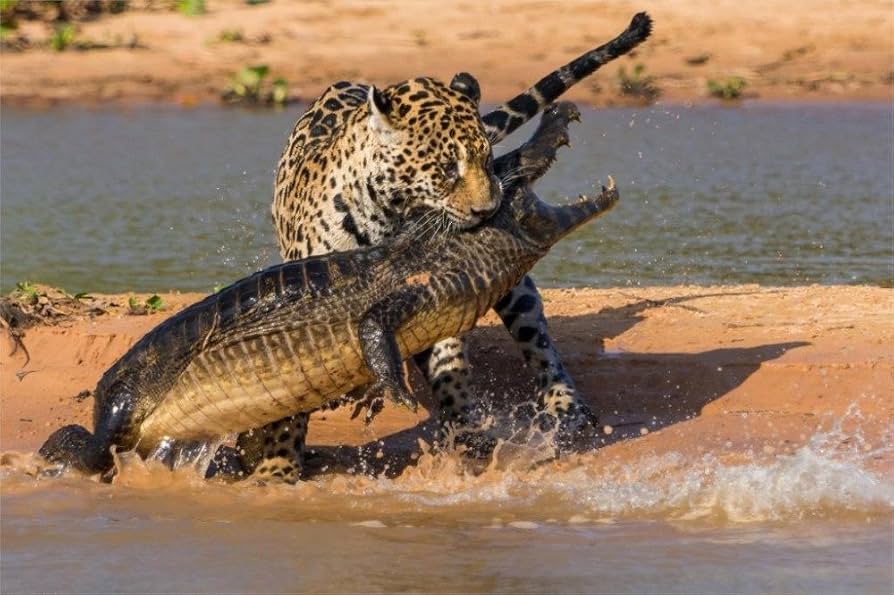
Most animals instinctively avoid waters inhabited by crocodilians. But deep in the wetlands of South America, one extraordinary predator actively hunts them.
Meet the jaguar — a big cat so powerful that even armoured reptiles can become its prey.
While lions dominate the African savannah and tigers rule the forests of Asia, the jaguar has developed remarkable adaptations that allow it to hunt both on land and in water.
Meet the Jaguar: South America’s Apex Predator
The jaguar is the third-largest living cat in the world, behind the tiger and lion.
Its compact, muscular body and exceptionally powerful jaws make it one of nature’s most impressive hunters.
- Weight: Large males can exceed 120 kg.
- Top speed: Approximately 80 km/h over short distances, according to commonly cited estimates.
- Habitat: Forests, wetlands and grasslands across Central and South America.
- Special abilities: Swimming, climbing and ambush hunting.
- Diet: Caimans, capybaras, deer, turtles and numerous other animals.
Unlike many other cats, jaguars are comfortable entering water in pursuit of prey.
Why Do Jaguars Hunt Caimans?
In Brazil’s Pantanal, one of the world’s largest tropical wetlands, jaguars regularly hunt caimans — reptiles belonging to the same order as crocodiles and alligators.
Caimans are abundant throughout the region, making them an important food source for some jaguar populations.
While these reptiles possess powerful jaws and protective armour, jaguars have evolved the physical strength and hunting abilities necessary to overcome them.
The Jaguar’s Extraordinary Bite
One of the jaguar’s greatest advantages is its exceptionally powerful bite relative to its body size.
Its robust skull, muscular jaws and large canine teeth allow it to penetrate remarkably tough materials, including turtle shells.
Unlike many other big cats, jaguars are also known to deliver bites directly to the skulls of certain prey animals.
This remarkable adaptation helps explain why even armoured reptiles can become part of their diet.
Jaguar vs Caiman: Physical Comparison
| Category | Advantage |
|---|---|
| Agility on land | Jaguar |
| Aquatic mobility | Caiman |
| Protective armour | Caiman |
| Flexibility | Jaguar |
| Climbing ability | Jaguar |
| Ambush hunting | Both |
| Hunting versatility | Jaguar |
Could a Jaguar Defeat Any Crocodilian?
Not necessarily.
Although jaguars regularly prey on caimans, larger crocodilian species present an entirely different challenge.
A fully grown Nile crocodile or saltwater crocodile can weigh several times more than a jaguar. Such an encounter would be extremely dangerous for the cat.
Even within South America, exceptionally large black caimans could pose a significant threat.
The jaguar’s success depends on the size of its prey, environmental conditions and the circumstances of the encounter.
Why the Pantanal Is the Jaguar’s Kingdom
Brazil’s Pantanal provides an extraordinary environment for jaguars.
Its extensive waterways, abundant wildlife and seasonal flooding create ideal conditions for a predator comfortable hunting on both land and in water.
Researchers and wildlife photographers have documented numerous encounters between jaguars and caimans in this region, revealing a remarkable relationship between two powerful predators.
Final Verdict: The Big Cat That Turns Predators Into Prey
The jaguar demonstrates that even heavily armoured predators are not always safe at the top of the food chain.
Its combination of muscular strength, powerful jaws, swimming ability and adaptability makes it one of the most versatile big cats on Earth.
For many animals, entering caiman-infested waters means danger.
For the jaguar, it can mean dinner.