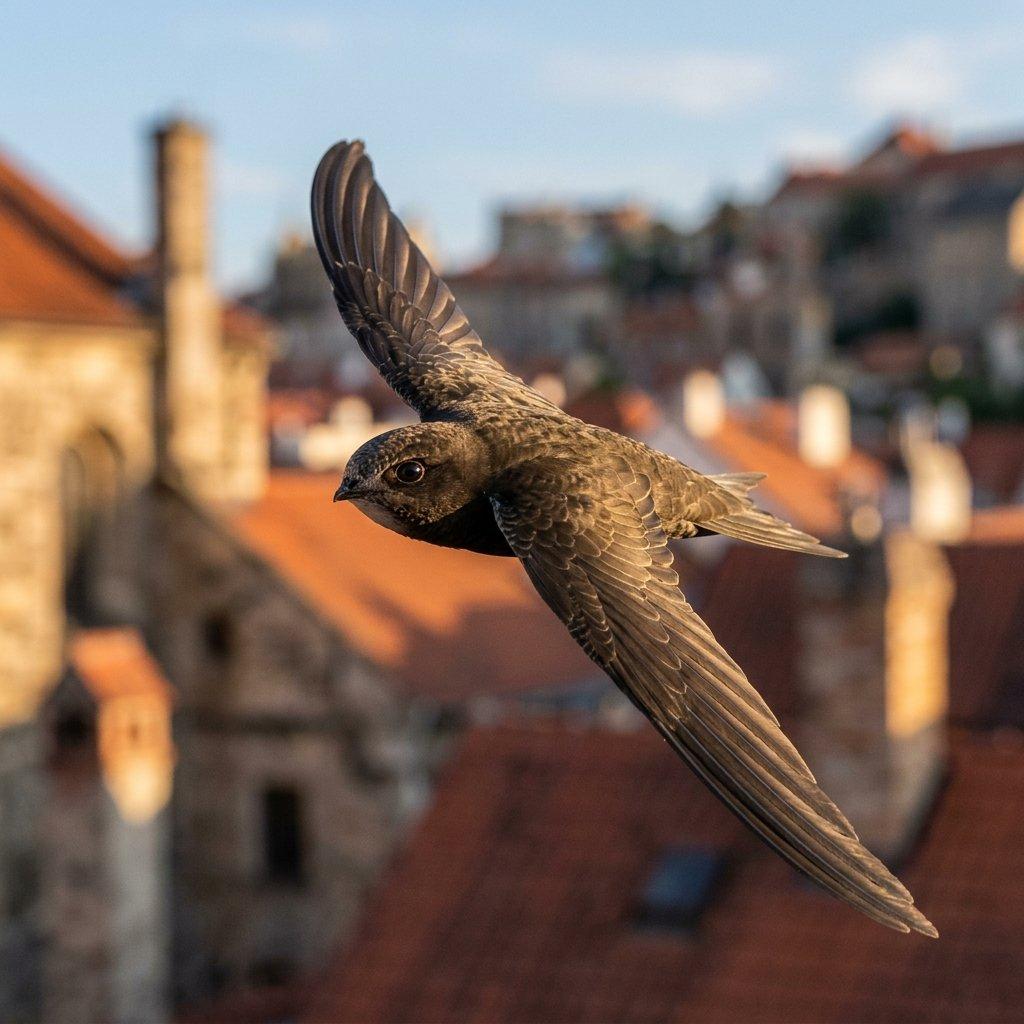
Imagine spending almost an entire year in the sky without touching the ground. No resting on branches, no sleeping in a nest, and no stopping for a break. For one remarkable bird, this isn’t science fiction. It’s everyday life.
A life spent almost entirely in the sky
Most birds follow a familiar routine. They fly in search of food, return to their nests, rest on branches and eventually settle down for the night.
But the common swift (Apus apus) follows a completely different lifestyle.
This small, dark-feathered bird is one of nature’s most impressive aerial specialists. It spends an extraordinary amount of its life flying, sometimes remaining airborne for approximately 10 consecutive months.
Unlike many other birds, common swifts rarely land except when they need to breed.
They spend their time travelling through the sky, catching insects, drinking rainwater and even gathering nesting materials while flying.
For a creature weighing only around 40 grams, this is an astonishing achievement.
How can a bird stay airborne for so long?
The secret begins with its body.
Common swifts have long, narrow, curved wings that are perfectly suited to efficient flight. Their streamlined bodies help them move through the air with relatively little resistance.
Their entire anatomy is adapted to an aerial lifestyle.
They are not built like birds that spend much of their time walking or sitting on branches. Their short legs and specialised feet make landing on flat surfaces difficult.
Instead, they are exceptionally comfortable in the air.
They can glide for extended periods, use air currents to conserve energy and make rapid changes in direction when chasing flying insects.
Their flight is not simply about speed. It is about efficiency.
What does it eat during these 10 months?
A bird cannot survive for months without food, and the common swift has developed a remarkably effective way of hunting.
It feeds almost entirely on flying insects and airborne spiders. Rather than searching for food on the ground or in trees, it catches its prey directly from the air.
It can spend hours flying through areas where insects are abundant, adjusting its altitude depending on weather conditions and the availability of food.
Swifts can also collect hundreds of tiny insects into a compact food ball inside their mouths before returning to feed their chicks.
This means that even while travelling enormous distances, they can continue eating without needing to land.
And eating isn’t the only activity they manage while flying.
Common swifts can also drink by skimming low over water and taking water directly with their mouths. They even mate in flight.
Essentially, the sky provides almost everything they need to survive.
The mystery of how they sleep while flying
Perhaps the most fascinating question is also the one scientists are still trying to understand fully.
How does a bird sleep when it spends almost its entire life in the air?
In 2016, researchers from Lund University in Sweden published a groundbreaking study in the scientific journal Current Biology.
They attached tiny electronic tracking devices to 13 common swifts to monitor their movements and flight activity.
The results were extraordinary.
During their approximately 10-month non-breeding period, the birds spent more than 99% of their time airborne. Some individuals did not land at all during the entire period.
The researchers also noticed something unusual.
Around dawn and dusk, the birds regularly climbed to impressive altitudes, sometimes reaching approximately 2–3 kilometres above the ground.
One possible explanation is that these high-altitude flights are connected to how swifts rest or sleep.
Scientists have suggested that they might sleep during periods of gliding, potentially using brief periods of reduced activity while remaining airborne.
However, the exact mechanism has not yet been established.
That means one of nature’s most extraordinary endurance performances still contains an unanswered mystery.
PubMed+1
A journey between continents
The common swift is also an impressive long-distance migrant.
Birds that breed across Europe travel south towards sub-Saharan Africa when the European summer comes to an end.
This is not a short journey. They travel thousands of kilometres between their breeding grounds and wintering areas, following seasonal changes in insect availability.
For a bird that weighs roughly 40 grams, this is an extraordinary migration.
The journey is made possible by its efficient flight, ability to exploit favourable air currents and capacity to find food while travelling.
When spring returns to Europe, the swifts make the journey north again.
Their arrival is so closely associated with the beginning of summer in Britain that many people recognise the season by the familiar screaming calls of swifts racing above rooftops.
Apus Apus+1
Why do common swifts finally land?
There is one major exception to their extraordinary aerial lifestyle: breeding.
During the breeding season, adult common swifts return to land-based nests, usually hidden inside holes and cavities in buildings.
They often return to the same nesting site year after year.
Here, they lay their eggs, incubate them and raise their chicks.
Unlike many birds, they don’t need to spend much time collecting nesting materials from the ground. They can gather feathers and other lightweight materials while flying, which are then held together using their own saliva.
Once their chicks are old enough and the breeding season ends, the adults return to their aerial lifestyle.
For roughly 10 months, the sky becomes their home once again.
Apus Apus+1
A remarkable bird that is quietly disappearing
Despite their extraordinary abilities, common swifts face a serious conservation challenge.
In the UK, their population has declined dramatically. The loss of traditional nesting sites is considered one of the important factors.
Swifts frequently nest in small gaps beneath roof tiles, eaves and within older buildings. When buildings are renovated, these openings are often sealed, unintentionally removing places where the birds can raise their young.
A reduction in flying insects also threatens their food supply.
Conservation organisations encourage homeowners and builders to consider installing specially designed swift nest boxes and retaining suitable nesting spaces when renovating buildings.
It is a relatively simple way to help a bird that has evolved to spend almost its entire life in the sky.
Final thoughts: Nature’s ultimate flying machine
The common swift is proof that evolution can produce extraordinary adaptations.
A bird weighing less than a small smartphone can travel between continents, catch food in mid-air, drink while flying and remain airborne for almost an entire year.
It doesn’t need a tree branch to rest every night or a regular place to return to.
For most of its life, the sky is its home.
And perhaps the most incredible part is that scientists are still investigating exactly how this tiny bird manages to rest during such an extraordinary aerial journey.
The next time you see a group of dark, curved-winged birds racing above rooftops, take a closer look. You might be watching one of the greatest endurance athletes in the natural world.