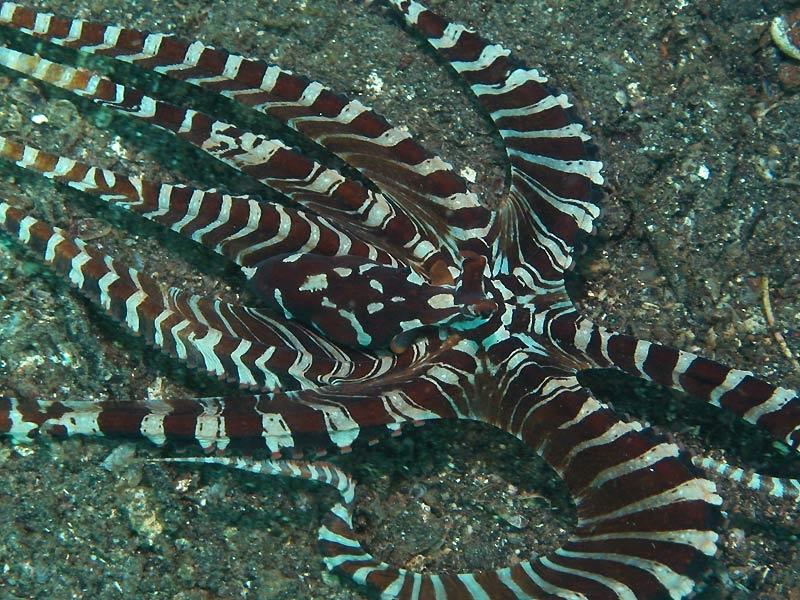
Imagine encountering a sea creature that suddenly transforms into something completely different. One moment it looks like an ordinary octopus. The next, it appears to be a poisonous sea snake or a dangerous lionfish. This isn’t science fiction. It’s the extraordinary mimic octopus, one of the ocean’s most fascinating masters of disguise.
Deep beneath the warm tropical waters of Southeast Asia lives an animal with an unusual survival strategy.
It doesn’t rely entirely on speed, strength or camouflage to avoid predators. Instead, it uses an extraordinary ability to imitate other marine animals.
Meet the mimic octopus (Thaumoctopus mimicus).
Unlike most octopuses, which are famous for changing their colour and blending into their surroundings, this species can imitate the appearance and movements of entirely different creatures.
And some of its transformations are remarkably convincing.
An Octopus That Can Pretend to Be Other Animals
The mimic octopus was scientifically described in 1998 after researchers documented its unusual behaviour in Indonesian waters.
Scientists observed that it could imitate several different marine species, including animals that predators would prefer to avoid.
Among its best-known impersonations are:
- Sea snakes: It can extend several arms and move them together in a way that resembles a banded sea snake.
- Lionfish: It spreads its arms around its body, creating an appearance similar to the long, venomous-looking fins of a lionfish.
- Sole fish: It flattens its body and moves along the seabed in a way that resembles a flatfish.
These are not simply colour changes. The octopus alters its posture, movements and the arrangement of its arms to create a convincing imitation.
Why Would an Octopus Pretend to Be a Dangerous Animal?
The answer is survival.
The mimic octopus lives in relatively exposed sandy and muddy environments where hiding places can be limited.
It faces potential threats from larger marine predators, so being able to imitate animals that predators recognise as dangerous can offer a significant advantage.
For example, a predator approaching an octopus might reconsider its attack if the animal suddenly resembles a venomous sea snake.
This strategy is known as Batesian mimicry, where a relatively harmless species resembles a potentially harmful or dangerous one.
However, scientists are still studying the exact circumstances in which mimic octopuses choose particular imitations.
Does It Decide Which Animal to Imitate?
This is perhaps the most fascinating part.
The mimic octopus does not appear to perform the same transformation every time it encounters danger.
Its behaviour can vary depending on the situation and the potential threat.
Researchers have suggested that it may select particular imitations based on which predator is approaching.
This suggests a remarkable level of behavioural flexibility.
Rather than relying on one fixed defence, it has several possible ways to respond to danger.
It Can Change More Than Just Its Appearance
Octopuses are already famous for their ability to change colour and texture.
Specialised skin structures called chromatophores help them rapidly alter their appearance. Other skin structures contribute to changes in texture.
The mimic octopus combines these physical abilities with sophisticated body movements.
Its arms are particularly important. Because octopuses have no rigid skeleton, they can bend, extend and arrange their arms in extraordinary ways.
This flexibility allows the mimic octopus to create shapes that would be impossible for most other animals.
One of the Ocean’s Most Extraordinary Survivors
The mimic octopus is a powerful reminder that survival in the natural world doesn’t always depend on being the biggest or strongest.
Sometimes, the best defence is being something your enemy doesn’t want to attack.
With its remarkable ability to imitate other marine creatures, the mimic octopus has developed one of the most unusual survival strategies found in the ocean.
And perhaps the most incredible thing is that this fascinating animal is not pretending to be just one creature.
It has an entire collection of disguises.
In a world where predators are constantly searching for their next meal, the mimic octopus has discovered an extraordinary way to make them think twice.