Iam grateful no one else is in the room with me. In principle, I’ve no problem with my family seeing me cry: but blinking away hot salty tears while watching Ozzy Osbourne? That seems somehow ludicrous. This is, after all, the self-styled prince of darkness, a trickster-like figure – one part devil, one part joker, one part joke.
I thought I knew Ozzy – we all thought we knew him, whether we liked him or not. He was the fresh-faced, charismatic vocalist of Black Sabbath. He was the bloated, crazed, drug-addled artist who bit the head off a dead bat onstage and once tried to strangle his wife. Later in life he was the lovable, bewildered paterfamilias on The Osbournes reality TV series. For some, he was also the artist with a back catalogue on which much of metal still rests.
The Ozzy that is making me cry is none of those things.
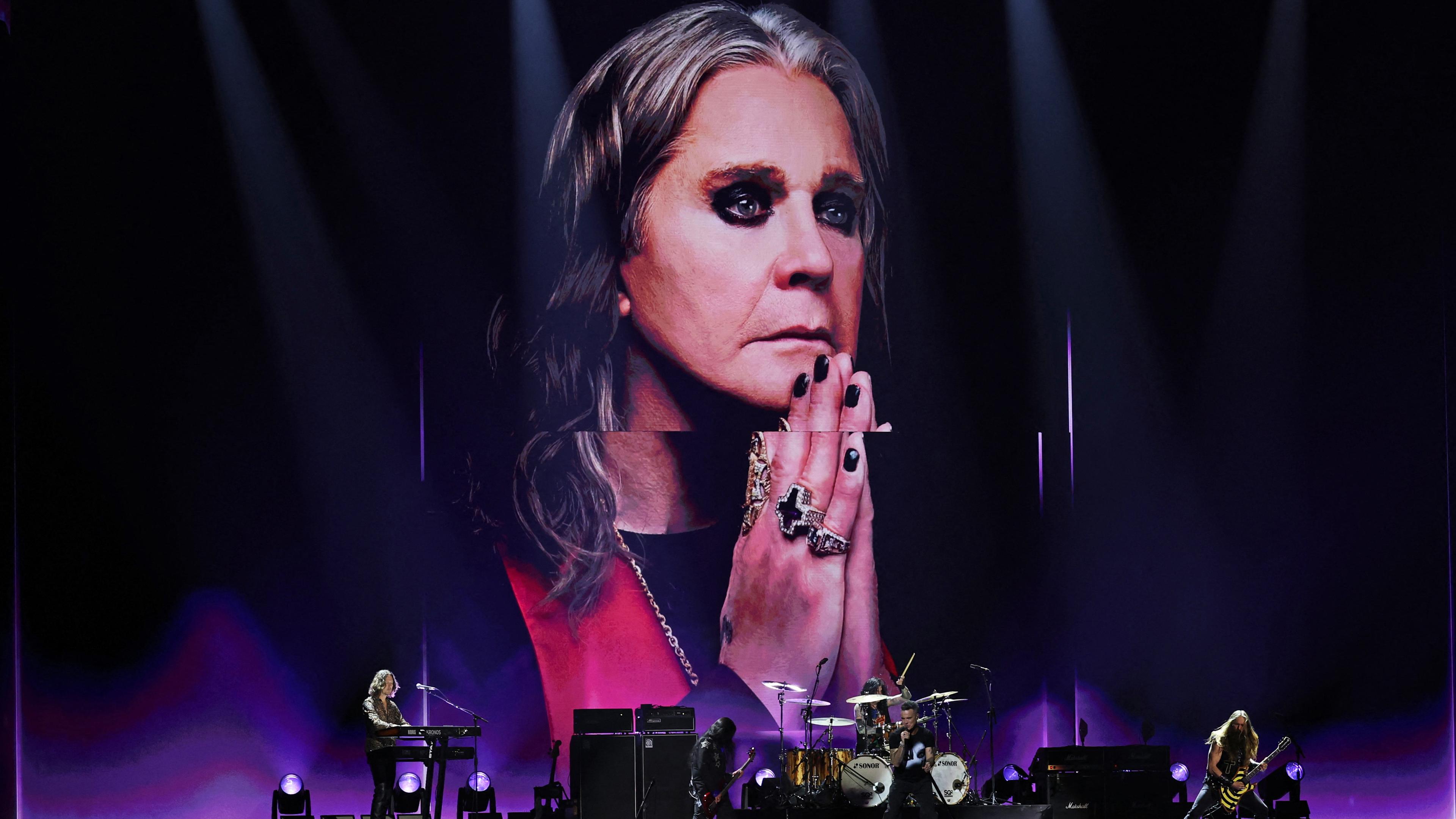
Here I am, in the easy chair in our living room, laptop balanced on my thighs, my recently broken ankle encased in a support boot and raised up on a bolster. Weeping. My lower leg and foot prickle with heat on this sultry day in July 2025, and I cannot take my eyes off Ozzy performing the final show of his illustrious career, at Villa Park in Birmingham, UK, before an ecstatic audience, and for those like me who have paid for the live stream. There are no antics, no wide-eyed devilish grin, none of the incessant running back and forth that we’re used to from him. Instead, he sits on a bat-shaped throne, singing with an appalling intensity, and occasionally demanding that the crowd clap along.
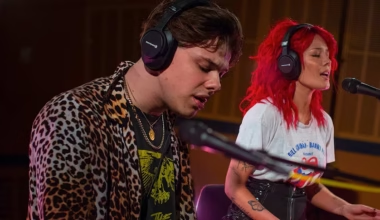
All day long I’d been watching metal’s great and good perform brief sets in honour of the man who inspired so many of them. Grizzled veteran megastars like Metallica, emerging legends like Gojira and fresh-faced talents like Yungblud and Lzzy Hale – all of them merely support acts just for one day, playing brief sets in which Ozzy/Sabbath covers predominate. Now, finally, it’s Ozzy’s turn.
He had been waiting for this moment to say a final goodbye for years. Health problems and the COVID-19 pandemic meant he’d had to cancel most of his farewell tour. Three years on from his only stage appearance since then (a couple of songs performed at a 2022 NFL game), he is obliged to perform seated due to a litany of medical complaints: Parkinson’s disease, acute back and neck trouble, and a whole lot else. You can see that singing takes everything he has left. He wants to stand, to run, to be the embodiment of rock and roll that he once was. It’s heartbreaking.
Ozzy professes his love for us and we return it, myself included. Even viewed on a laptop screen from my own sick chair, it feels like a deluge of emotion. A surfeit of love, pain, frailty and loss are converging on my own frail body.
When I first discovered Ozzy and metal, as a child on the cusp of adolescence, metal bodies seemed like the embodiment of strength and virility. The tousled locks, the phallic guitar poses, the distortion, the screams and the implausible vibrato – all this felt like what a man should be. Metal bodies thrilled me, the more so since, as a skinny, nebbish Jew, I felt I could never inhabit one.
He was always different, pudgy, vulnerable, a ball of emotion and confusion
My Jewish North London upbringing was settled, middle class, rule bound. Metal was none of those things and nor was Ozzy. Metal was confrontation, insensitive and insouciant to the loathing and derision its artists received from the mainstream music majority. Ozzy lived a life wilfully devoted to the pursuit of shock. His music, and metal more generally, explored the darkest of themes; violence, death and suicide, the occult, all the delights of transgression.
Yet, had I looked a little deeper, I would have discovered a different Ozzy that coexisted with the one I knew; an Ozzy I might have found common ground with. Physically, he was never a metal god either. He was always different, pudgy, vulnerable, a ball of emotion and confusion, far from the image of masculine mastery. Like me, he desperately felt he had to embody metal. Like me, he frequently felt shame for the weakness of his flesh. Unlike me, he somehow became the apotheosis of metal masculinity.
Ispend the week before the show suffering, after slipping down the stairs in the middle of the night. It was my daughter’s Father’s Day card that I slipped on – a metaphor I don’t even want to think about. After a couple of days hobbling around the house, I give in to reality and get an X-ray. While I am waiting for the results, my son calls to tell me he was awarded a first class in his honours degree. I yelp. Then I learn that my ankle is fractured.
I spend the day before Ozzy’s final show alternately being wheeled and limping around a university town for the ceremonial awarding of my son’s degree. It’s a luminous, barely believable day, as I remember my son’s late diagnosis of dyslexia and the educational turmoil he’d had to cope with during the pandemic.
Ozzy’s brave performance stirs an emotional pot already full to the brim
In the afterglow of these hours spent marinating in love, and as I watch Ozzy declaring his love for the crowd, I can’t entirely banish the undercurrent of guilt that never leaves me on account of another bond of love: my immobility means that I haven’t been to visit my father today, in the nursing home where he has been confined for nearly a year. Like Ozzy, my dad has Parkinson’s disease and much else; standing up is a chancy enterprise for him. This week he won’t receive the fleeting comfort of a visit from me. It was my turn to be the man, to take over from the one who once carried me. Instead, there is only my weakness.
A weak father, a weak son; immobile while watching a weak man somehow transcend his desperate situation. So I cry, as Ozzy’s brave performance stirs an emotional pot already full to the brim.
I’ve spent years studying metal as a scholar and writing about it anywhere that will publish me. I know that metal today is a more diverse place. London’s best metal pub has a vegan menu and its best metal record store has an alcohol-free bar; metal festivals have viewing platforms for people with mobility issues. Metal is even used as a resource in support groups and 12-step programmes. Yet Ozzy’s performance still shocks me into a different kind of understanding. Who knew that metal could be a place where one of its most notorious stars could perform this achingly sad display of vulnerability and yearning?
Confined to his throne-cum-prison, Ozzy clearly feels something of this unnerving surprise himself. You can tell that his frustration with his disability is tinged with a portion of shame. He loves the love he’s getting, but he can’t play the transgressive part he’s played for so long. The pathos of his evident grief, his mourning the loss of what he once was, is hard to witness.
What appears to be metallic hardness is but a patina for something else
Ozzy may have helped create heavy metal but that doesn’t mean that he fully understood his creation, its possibilities and potential. Then again, for much of metal’s history, neither did anyone else. We were all sucked into the myth that the metal men were selling, to the point where we sometimes forgot that it was a myth.
As a scholar, I learn fast. As a person with a body and a propensity for shame and anxiety, I learn achingly slowly. I wish that, years earlier, I’d internalised what I’d learned metal could be. Like Ozzy, I too have a body that fails me on occasion (I’ve had chronic fatigue syndrome for more than 30 years). Even before that, I never much liked my gawky, ungainly body anyway: I loved metal, but felt I couldn’t be metal. I wrote about the softness at the core of the metal body long before I accepted the squishiness in my own metal bone locker. Yet like Ozzy, I was more metal than I ever could have imagined.
Something had begun to shift for me in the years preceding Ozzy’s final concert. For this male Jewish weakling, metal and shame were natural bedfellows. My children were raised to be shameless: their musical tastes and their frailties were matters of fact. They both found their way to metal with little help from me.
Metal has become the place where my body can betray me, where I can be weak
My daughter fell particularly hard for metallic art. As an autistic person, she knows about limits and excess – meat and drink to metal culture. For years now, I’ve been taking her to gigs. Most recently, as she suffered through an energy-limiting conditions in her late teens, I’ve wheeled her into the disabled section at multiple venues. Unlike Ozzy and unlike me, she was unembarrassed about sitting down. She knew that metal was an ode sung by and to and about fallible bodies. She knew she was metal.
If only Ozzy had known that, too. He knew only the contrast between what he had once tried to be and what he now was: that the monumental myth had crumbled. And I, caught between my daughter’s generation and Ozzy’s, wept tears of sadness for what he would never understand – and tears of happiness for my children’s lack of shame (mingling with tears of pain as my ankle throbbed).
I always thought I would move on from metal as I aged. The opposite happened: following my daughter’s example, metal has become the place where my body can betray me, where I can be weak, where I can acknowledge my frailty. Looking round the audience at gigs, I can see that I am not the only one who knows this.
Ozzy died just 17 days after his final concert, on 22 July 2025. This time I didn’t cry. When I heard the news, I thought ‘How perfect!’ To end one’s life this way, after a mega performance of loving and being loved, was a beautiful thing. For one night only, Ozzy became the one who could strip bare my defences and make me feel. And what a blessing it was to be immobile at the time, joining my dad, my daughter and Ozzy in that place where there is no hiding from the fact that flesh is weak.